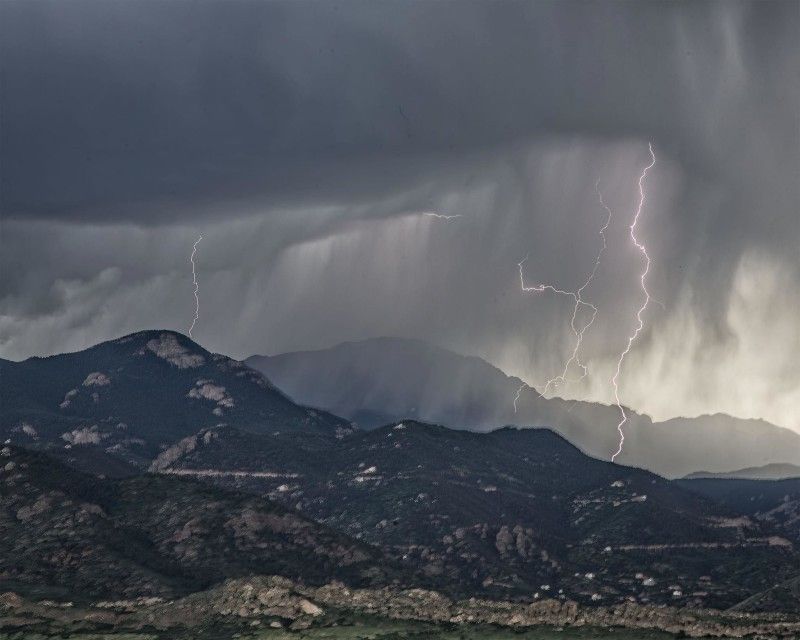

(COLORADO SPRINGS) — Colorado is a hot spot for frequent lightning and deadly strikes, ranking fourth in the country for the number of deaths due to lightning.
There is one place in the state that sees the highest number of flashes – the Pikes Peak Region. And the highest number of injuries and deaths due to lightning is in El Paso County.
“Around the Pikes Peak Region, Rampart Range, Monument Hill, there tends to be the highest concentrations there,” said Meteorologist Paul Steward, with the National Weather Service in Pueblo.
This chart highlights how high the concentration of strikes is, especially during the month of July.
The graph above shows the average number of CG flashes which occurred over the state of Colorado from 1996 to 2016 (21 years inclusive) for each day of the year (blue line). A 7 day running mean is also shown (red line). Courtesy: NWS Pueblo.
On an average July day, there is more than 5,300 lightning flashes across Colorado.
The map above shows a rough average of the number of cloud-to-ground (CG) lightning flashes for each county in the state of Colorado. Multiply the value above by 1000 to get the value. Courtesy: NWS Pueblo.
“Topographically speaking, the orographic lifting of the mountains makes a lot more susceptible for there to be frequent lightning. Especially as thunderstorms are intensifying over that region, there could be lightning jumps and you get a lot more lightning concentrated over that area,” said Steward.
You can see the density of lightning strikes over the Palmer Divide, where the red dots are clustered on this map.
Above is a CG flash density map for the state of Colorado (data from 1996 through 2016.) Courtesy: NWS Pueblo.
In this particular area, stretching south from Denver into the Pikes Peak Region, wind flow interacts with the terrain features in a unique way.
Colorado’s topography, where Pikes Peak juts into the lower elevation plains, can get a combination of converging winds and more moisture near the surface. This leads to an area of enhanced spin, which causes more active weather.
When weather factors come together, this warm season circulation has been shown to play a big part in strong storms and tornadoes developing over/near the Front Range. Even compared to other high elevation spots in Colorado, the Palmer Divide by far produces the most lightning. But it’s also the type of lightning we get here.
Dry lightning is common in Colorado because air near the ground is drier than actual clouds above it. While dry thunderstorms have the same amount of lightning as regular storms, much less rain falls so these storms can sneak up on us.
“Lightning will channel through the rain shaft. So if you’re standing immediately under one of those thunderstorms and it’s typically very dry, but you’re caught off guard,” said Steward.
In an average year, about 500,000 lightning flashes hit the ground in Colorado. July is the most active month, with June and August following.
This chart highlights 2:00-5:00 p.m. as the timeframe where lightning is most active. We all know the saying ‘when thunder roars, go indoors’ and that’s especially important during the summer when late afternoon storms are common.
Click here for more information on lightning casualties by county in Colorado. To learn more about how to stay safe if you’re caught out in a storm, click here for resourses from the National Weather Service.
“So if you’re out there hiking and you’re up on a mountain, your chances of getting struck go up tenfold. It’s always best if you are caught in the thunderstorm and you’re up high in the mountains, get inside your vehicle. That’s actually one of the safest places you could be,” said Steward.