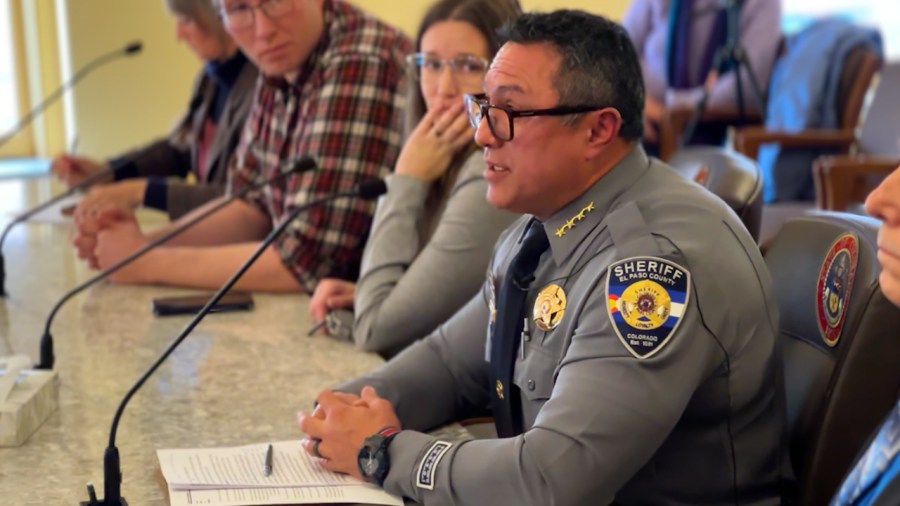

(DENVER) — In a contentious session on Thursday, Feb. 22, a state committee dealt a blow to efforts aimed at reinstating collaboration between local law enforcement and federal immigration agencies. The vote came down after multiple Southern Colorado Sheriffs spent the day testifying in favor of the bill.
The House State, Civic, Military, and Veterans Affairs Committee, in an 8-3 vote largely along party lines, rejected HB24-1128, the Enforcement of Federal Immigration Law bill. The bill sought to overturn existing laws that restrict local law enforcement’s engagement with Immigration and Customs Enforcement (ICE) to arrest, detain, and deport undocumented immigrants.
During the extensive two-hour hearing, sheriffs representing Douglas, Teller, and El Paso counties testified on behalf of the coalition championing the bill, comprising over a dozen sheriff’s offices, primarily from Southern Colorado.
El Paso County Sheriff Joe Roybal, a vocal supporter of the bill, expressed disappointment at the outcome but reaffirmed the importance of presenting his case before the committee.
“It was worth my time for my community. I made a promise to my community before I was elected, and I’m living up to that promise,” Roybal remarked after the decision.
Roybal emphasized that just as local law enforcement collaborates with various other federal agencies like the Federal Bureau of Investigation (FBI), Drug Enforcement Administration (DEA), the Armed Forces, working with ICE should also be within their purview.
The bill faced staunch opposition from Democratic lawmakers, who raised concerns about its potential for promoting racial profiling and undermining due process. Their objections were particularly directed at a section of the bill that would allow peace officers to notify ICE based on “probable cause” of an individual’s undocumented status.
Rep. Kyle Brown, (D-Boulder) criticized the bill as regressive.
“This bill literally takes us back to a time, a dark past I would argue, when the state considered whether someone had ‘papers’ in this particular way,” said Brown. “This bill allows peace officers to be both judge and jury of people who have not been convicted of a crime and allows the use of subjective criteria to establish that.”
Teller County Sheriff Jason Mikesell emphasized the bill’s intention to focus on collaboration with ICE to address serious, high-level criminal activity.
“We’re not asking to be immigration officers,” Mikesell stressed.
Mikesell highlighted instances that posed a threat to public safety where repeat offenders were able to evade detection by federal immigration authorities. However, opponents argue that existing laws are sufficient to address criminal behavior regardless of immigration status.
“Crimes are still crimes… Murderers, pedophiles, sex traffickers are still going to be held accountable under the law,” asserted Rep. Javier Mabrey (D-Denver).
This sentiment was echoed by community members who testified against the bill, recalling the repercussions of similar laws enacted in 2006.
Highlighting their own distressing experiences back then, one testifier whose parents were undocumented said, “A simple traffic stop could quickly turn into the separation of our family and we would be ripped away from our community. We feared the possible outcome that would occur if ICE was contacted. A story many immigrant families in our state know all too well.”
The committee’s decision to reject the bill also included a vote to indefinitely postpone the bill, effectively halting its progress in the legislative process.