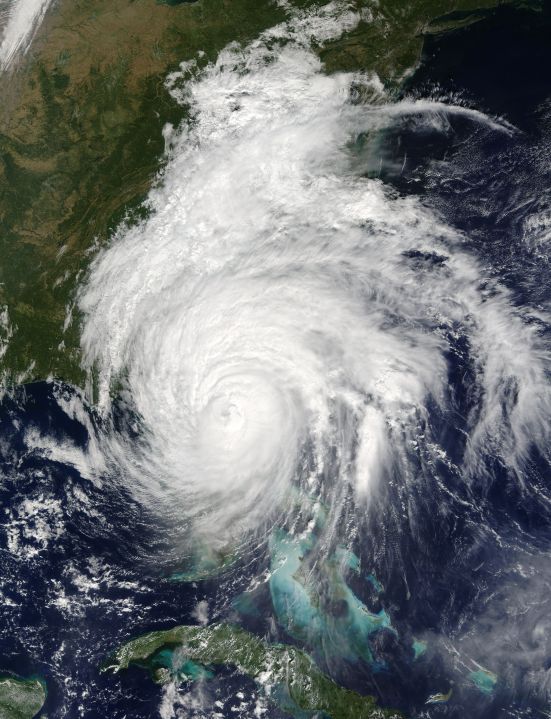

(NATIONAL) — A powerful category one hurricane is swirling in the Gulf of Mexico and is rapidly gaining strength. The storm system will slowly meander to the north over the next couple of days before making an expected landfall near Florida’s Big Bend coast on Thursday, Sept. 26.
As of Wednesday evening, Helene is boasting sustained winds of well over 80 mph. The system is moving north at about 10 mph. This slow march is giving the hurricane ample time to continue organizing and intensifying.
Currently, the Gulf of Mexico is also reporting sea surface temperatures well over 80 degrees Fahrenheit. These extremely warm temperatures are directly fueling Helene and allowing it to get even stronger; the National Hurricane Center (NHC) is warning for potential rapid intensification as the system moves over these warm waters.
With this rapid intensification possible, the NHC is now warning of a category 4 landfall. Regardless of the category, impacts will be felt everywhere for the state of Florida and surrounding Gulf states. Hurricane warnings are in place for much of the Big Bend region along Florida’s west coast.
After landfall, the hurricane is expected to weaken but still pose a significant threat to the Southeast. As the system weakens it will move further inland and up to the north. During this time, an already existing area of low pressure will begin to interact with the decaying hurricane.
The Fujiwara effect is a meteorological phenomenon in which two low-pressure systems interact. The interaction is often described as a sort of ‘dance’ and typically involves two tropical systems. However, a combination of any two low-pressure systems (with varying magnitude) may interact in this way. When two of these systems get close enough to each other, their dynamics start to pull on one another and can heavily influence local weather.
In the ‘Pattern Evolution’ video above, the purple/pink masses represent areas of energy and are associated with low-pressure disturbances. As the video progresses, you can see hurricane Helene (also considered a low-pressure system) start to rotate around the first system near western Tennessee. The two systems will swirl around each other until one of a few different things happens:
The systems spin around each other once or twice and eventually go their separate ways
The systems interact and collide too much, leading to one or both of them falling apart
On rare occasions, the two independent systems may interact in a way that produces a single bigger system with increased energy
This situation is rapidly evolving for interests in the Gulf of Mexico and specifically Florida’s Big Bend region, so be sure to check with local state officials for up to date information.