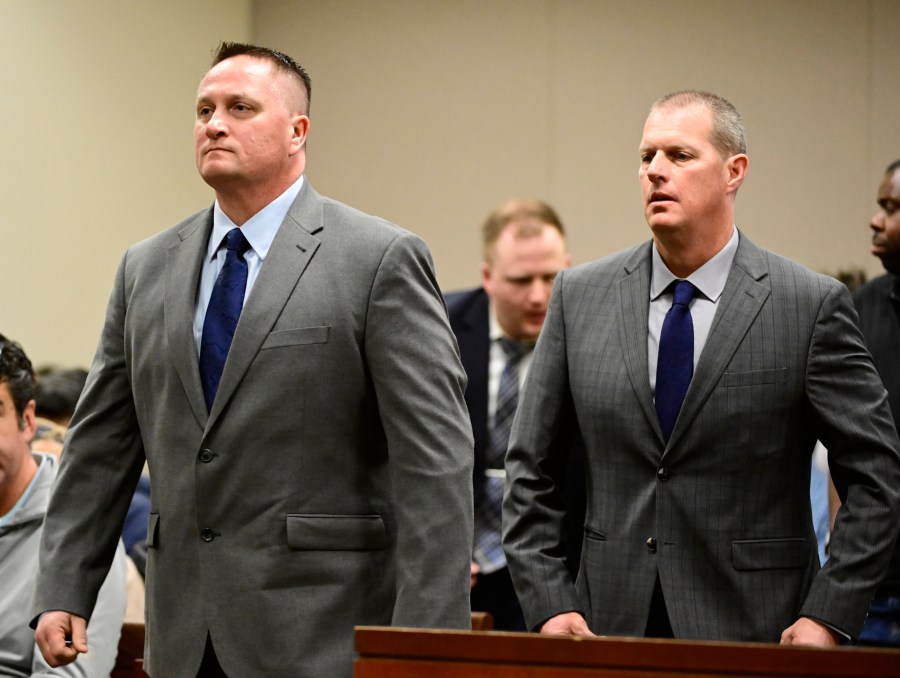

DENVER (KDVR) — Both paramedics charged in connection to the 2019 death of Elijah McClain were found guilty of criminally negligent homicide by an Adams County jury on Friday.
Aurora Fire Rescue paramedics Jeremy Cooper and Peter Cichuniec were both found guilty of criminally negligent homicide. Cichuniec was also found guilty of one second-degree assault charge related to unlawfully administering ketamine without consent.
Cichuniec was found not guilty of a second count of second-degree assault intended to cause bodily injury.
Cooper was found not guilty of both counts of second-degree assault.
Cichuniec was taken away from the courthouse in handcuffs, according to FOX31 reporter Andrea Henderson. Cooper will be allowed to remain free until sentencing.
The charges stem from actions taken by the first responders on the night of Aug. 24, 2019, while responding to a 911 call for a suspicious person.
That person was McClain, a 23-year-old Black man, who died six days after he was stopped and forcibly restrained by Aurora police officers, then injected with an overdose of ketamine, a sedative, by paramedics.
A revised statement by the coroner said McClain died due to ketamine administration following forcible restraint.
Closing arguments in the paramedics’ trial took place Wednesday afternoon, after which the case was turned over to the jury for deliberations.
Three officers have already stood trial for their alleged actions on that night. Two were acquitted, including one who has since returned to work as a police officer, and the third was convicted of criminally negligent homicide and third-degree assault.
Aurora Fire Chief, McClain family offer comments
Sheneen McClain has been largely silent about the case to media members, besides a statement issued Thursday, but a family spokesperson gave an impassioned speech following Friday’s verdict.
“This story is Sheneen McClain’s story and Elijah McClain’s story,” the spokesperson said. “What I will say is when something happens to one of us, it happens to all of us. I watched as the prosecution delivered the truth about what happened to Elijah in 2019. The truth is now real and it is available to the people.”
She also said that all involved have said that Elijah should still be alive.
“God made a promise to all of us when he made Elijah,” the spokesperson said. “This young man had a spirit that was sweeter than any of us could try to be. Self-taught violinist, self-taught guitarist. And upon his murder, he was mastering the oboe.
“He was called to be a healer, so he went into massage therapy,” she continued. “And from what I understand, some of the Aurora police officers were actually some of his clients. He was called to be a healer.”
She said Cooper, Cichuniec, Randy Roedema, Jason Rosenblatt and Nathan Woodyard “denied all of us the promise God made to us when he made Elijah.” She noted that the world will never know him as a father or husband.
“We are still seeking justice,” she said. “Thankfully, in this case, the algorithm continues, but we do not know justice until we see sentencing.”
Aurora Fire Rescue Chief Alec Oughton released a statement following the verdict.
“I’m deeply concerned and disappointed that our medics, Peter Cichuniec and Jeremy Cooper, have both been convicted of Criminally Negligent Homicide in the trial stemming from the death of Mr. McClain,” Oughton said. “While I appreciate the jury’s diligence, integrity and public service to ensure a fair trial, I am discouraged that these paramedics have received felony punishment for following their training and protocols in place at the time and for making discretionary decisions while taking split-second action in a dynamic environment.
“The community has asked for true pathways to accountability, transparency and justice to ensure incidents like this don’t happen in the future. We are committed to continuous improvement in our organization,” he added.
Oughton noted that AFR has taken specific actions to ensure a similar tragedy never occurs again. These include:
Re-establishing a medical branch within the department to oversee emergency medical procedures and incidents
Implementing protocols to clarify who is in charge when multiple agencies are at a scene
Requiring 100% quality-assurance review on all sedative administration and strict adherence to this new protocol
Implementing citywide protocols to dispatch the appropriate level of care to each call
Increasing communication and coordination with community groups and residents to gain input on how AFR can better serve them
Colorado Attorney General Phil Weiser, whose office has been prosecuting these cases, also offered a statement.
“We knew these cases would be difficult to prosecute,” he said. “We are satisfied with today’s verdict, and we are confident that bringing these cases to trial was the right thing to do for justice, for Elijah McClain, and for healing in the Aurora community.
“I am proud of our hardworking trial team that presented a strong case based on the evidence and the law against the paramedics,” he continued. “Indeed, the prosecution teams in the three trials brought to light the events that occurred that dark night. The world — Elijah and especially his mother Sheneen McClain— deserved to have the full story told. And justice demanded it.”
Other impacted groups provide statements
Charles Richardson, General Counsel for Aurora Fire Fighters Local 1290, gave a statement regarding the verdicts.
“It’s outrageous our paramedics received 1.5-2 hours of training and were told that ketamine had a wide safety margin, whereas the Attorney General brings in four doctors with 20, 25 and 30 years of experience in a hospital setting to say ketamine killed Mr. McClain,” Richardson said. “The criminalization of chemical sedation by firefighters has to be completely reevaluated. Based on this situation, I do not believe it’s fair or reasonable to require any firefighter to give anybody any chemical sedation.”
The International Association of Fire Fighters General President Edward Kelly also offered a statement.
“Today’s verdicts against Fire Fighter/Paramedic Jeremy Cooper and Captain Pete Cichuniec only compound this tragedy,” Kelly wrote. “Colorado Attorney General Weiser’s decision to criminalize split-second medical decisions sets a dangerous, chilling precedent for pre-hospital care in our country. There are far-reaching consequences we will address at a more appropriate time. But when politics drive prosecution – forcing fire fighters and paramedics to second-guess decisions – public safety is compromised.”
Aurora paramedics on trial for 4 weeks
This trial, similarly to the previous trials, focused on what ultimately killed McClain.
Defense attorneys argued that the paramedics followed their training in giving ketamine to McClain after diagnosing him with “excited delirium.” The condition is disputed, with some saying it is unscientific, and has been used to justify excessive force.
On Monday, both paramedics took the stand in their own defense. They told the jury they witnessed agitated behavior as officers handled McClain, and said they agreed upon a dose of 500 mg, and Cooper administered it.
Cichuniec told the jury Aurora Fire paramedics were taught the drug is “safe” and “will not kill them.”
Earlier trials note ketamine dose played a role
Prosecutors questioned the dosing of the ketamine and the characterization of excited delirium, and they questioned if paramedics gave appropriate care to a man who had been in a carotid hold, gone unconscious and vomited.
The officer who ultimately placed McClain in a carotid hold, Nathan Woodyard, was acquitted of charges in the 23-year-old death. Another officer had attempted to place McClain in a carotid hold earlier but failed.
Woodyard’s defense lawyers argued that the officer’s aggressive hold was not what ultimately killed McClain. Instead, they pointed to the paramedics, who injected McClain man with ketamine.
During Woodyard’s trial, the prosecution called Dr. David Beuther, a pulmonologist, who said the carotid hold set off a chain of events that made it harder for McClain to recover. He testified that McClain was put in a position that made it difficult for him to breathe, which caused him to choke on his vomit before the ketamine injection.
A forensic pathologist who testified as well said injuries at the hands of law enforcement contributed to McClain’s death and said he was in obvious distress because body camera footage showed he was having trouble breathing and appeared to be choking.
The Associated Press contributed to this article.