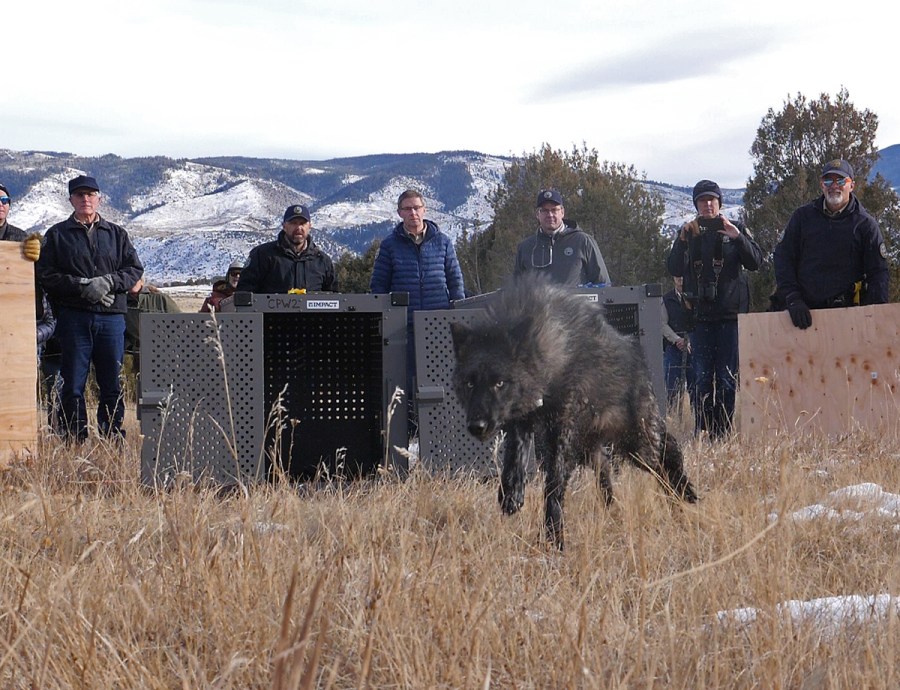

DENVER (KDVR) — Colorado’s reintroduced gray wolves have been tracked south of Interstate 70 for the first time since their release in December 2023, according to Colorado Parks and Wildlife.
The agency said that its biologists have noted GPS locations from the collared gray wolves south of I-70, even though watershed movement maps have been highlighted south of the interstate previously. The agency is currently tracking seven reintroduced wolves and three have died since December 2023.
The wolves’ movement is shared by CPW through the hydrology maps to help protect their locations.
“This kind of wildlife activity was anticipated,” CPW stated on Sunday.
The agency said the wolves need three things for survival: Food, connectivity with large wild landscapes, and space from humans. The agency said the wolves introduced to Colorado less than a year ago are exploring the state’s landscape, especially with growing wolf populations as they reproduce.
“Wolves are habitat generalists, meaning they can thrive in a wide variety of environmental conditions and habitats,” CPW said. “As long as prey is available, wolves can use a variety of areas. It is anticipated that wolves will expand widely over time.”
Anyone who believes they have seen a gray wolf is encouraged to fill out a CPW wolf sighting form, available online here.
More gray wolves to be released in winter 2024-25
The state plans to release up to 15 further gray wolves sourced from British Columbia, Canada, to be translocated into Colorado between December 2024 and March 2025.
This would be the second year of winter gray wolf releases in the state, having released 10 gray wolves sourced from Oregon in December 2023. The voter-mandated plan requires 10-15 gray wolves to be released in the state for 3-5 years.
In anticipation of this release, the state has been offering nonlethal deterrent training to ranchers and other livestock producers in the state. The goal is to prevent further conflict-filled springs like in 2024 when handfuls of livestock were reportedly taken by newly reintroduced wolves.
One high-conflict spot was later determined to be where a mated pair had their den, later titled the Copper Creek pack. The pack, which biologists originally said had six members, was captured in late August and early September to be relocated further from human settlements.
During that operation, the adult male wolf of the pack died from wounds it previously sustained.
Later, biologists identified a potential fifth pup in the Copper Creek pack that was still on the loose in the same area where numerous livestock deaths were reported. The goal originally was to capture that pup and reunite it with its litter mates, but the plan was halted after temperatures began to drop.