
(NATIONAL) — As the weather gets warmer, people are emerging from their burrows and having more get-togethers. Party hosts may wonder how to best satisfy their hungry guests. The answer is always cheese.
Whether serving chips and queso, grilled cheese, or a fancy fondue, cheese will please the masses. And nothing adds a touch of class to a gathering like a cheese and charcuterie board.
But how does one choose the cheeses that will appease the crowds? Below is a guide to building a simple cheese board that is sure to have something that everyone will like.
Logistics of feeding cheese to a party
The first question a savvy host must ask when building a board is how many people will be attending. This will help guide the number of cheeses to feature on the cheese board and how much of each cheese to buy.
In general, if the party features several food items or if the cheese board is meant for light grazing, the recommendation is to provide two to three ounces of cheese per person. If the cheese tray is a main component of the meal, three to four ounces per person is appropriate. If your party includes a cheese addict, all bets are off.
The next step is to determine whether the party has a theme or a specific pairing. A Mardi Gras party can include French varieties or a cheese flavored with Cajun spices. If the party includes certain wines or other beverages, it can be an added treat to research which cheeses complement them.
How to choose your cheeses
If you are a “turophile” or cheese connoisseur and already have a broad knowledge of cheese types, the only difficulty about choosing varieties for your board can be picking from a sea of favorites. For those who go cross-eyed when approaching the cheese counter, it can be a good idea to enlist the help of a cheesemonger. A good cheesemonger can ask questions to identify your needs and give helpful suggestions, and sometimes even offer a few taste tests.
A good rule of thumb for achieving optimum variety on a cheese board is to start with a sharp cheese and a soft, mild cheese, and then add something that goes in a different direction.
Sharp cheeses
The longer a cheese is aged, the stronger the flavor gets. Hard and semi-hard cheeses tend to become harder, drier, and sharper in flavor. This can add an exciting bite to your bite of cheese, and pairs nicely with sweet fruits like grapes or apples. Options include one-year-aged cheddar, Parmigiano Reggiano, or an aged Gouda, such as the Artikaas 18-month Gouda.
Gouda is good. And Artikaas 18 Month Gouda recently won gold at the World Cheese Awards, and has a firm texture and rich, salty flavor.
According to Whole Foods Market’s Certified Cheese Professional Alex Blair, 18 Month Gouda has “hints of butterscotch and walnuts. It’s sprinkled with those satisfying crunchy tyrosine crystals.”
Blair says he recommends enjoying the Gouda with an amber ale and pretzels.
Mild, soft cheeses
There is a wide variety of soft cheeses to choose from. Some are milder and more buttery in flavor, and others are… known for a certain odor. One of the most popular options for a soft cheese is brie. With its bloomy rind and gooey “paste,” it spreads easily on crackers or French bread.
Fromager D’Affinois (Froh-mahj Dah-fin-wah) is a double-cream brie that comes from France, near the Swiss border. This cheese is known for its silky texture and buttery flavor.
Blair says that this cheese is an excellent introduction to the world of brie and other bloomy-rind cheeses, and that it “pairs delightfully with any jam, making it a versatile option for various occasions.”
Cheeses that add flavor variety
It’s a little hard to go wrong in this category. This is your chance to include a cheese that you were secretly hoping the cheesemonger would recommend, or that you know one of your party-goers loves. In order to add variety to your cheese board, it can be a nice touch to add a cheese that doesn’t fit in the “mild” or “sharp” category.
This doesn’t narrow it down as much as one would think. Options include cheeses made from an alternative milk, such as goat’s milk or sheep’s milk. Some people like to include cheeses that have flavors infused during the cheesemaking process, such as herbs or fruit. A good classic choice, and one that’s hard to dislike, is a cheese from the Swiss family. And no, that doesn’t mean Robinson.
Even though Cave-aged Gruyere (Gree-yair), like Swiss cheese, is from the Alpine family of cheeses, it doesn’t have the same bitterness that Americans think of when they hear “Swiss Cheese.” That’s largely because it has more salt, balancing out the strong nutty flavors.
Blair says that Gruyere is known for its “grassy, nutty, and fruity notes,” and that it “is perfect for melting and pairs wonderfully with onion jam.”
Putting the board together
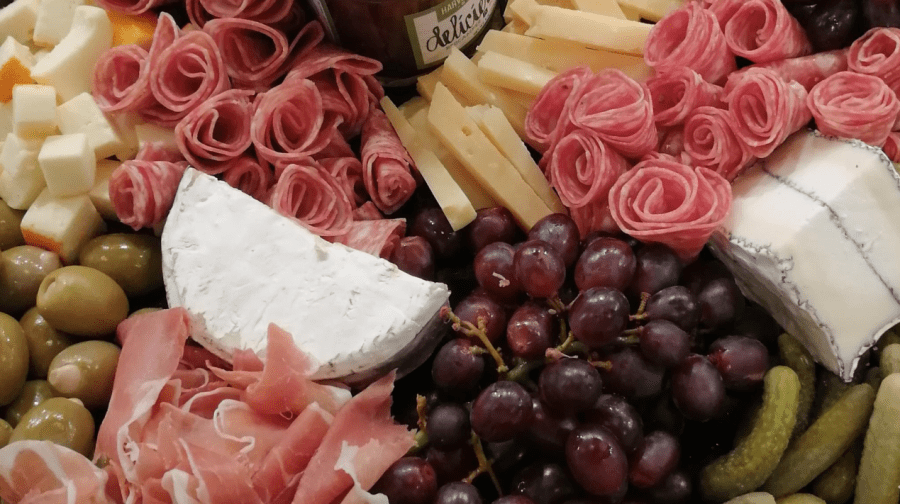
Once you have your cheeses chosen, it’s time to choose foods to complement them. This is when you put the “charcuterie” in the charcuterie board, including options such as your favorite salami, a thinly sliced ham, such as Prosciutto, or even pepperoni. Other options to add color and flavor to your board are olives, pickles, fruits such as grapes or dried apricots, and nuts such as candied walnuts or salted almonds.
When arranging the board, it doesn’t really matter how it looks, as long as people are able to put it on their plate and enjoy it, but if you want to elevate the appearance of your board, here are some tips:
Start with bigger items, such as a round of brie or a sprig of grapes, and space them out around the tray.
If you want to pre-cut the cheeses into bite-sized slices, you can vary the shapes into sticks, rectangles, and triangles, lending texture to the board. Feel free to get creative in how you stack, fan, or spread out the cheeses.
For the truly determined, thinly sliced salamis can be folded, rolled, or even arranged into flower shapes and snugged in between the cheeses, and Prosciutto can be rolled or loosely piled.
Finally, fill in the gaps with smaller elements, such as fruit pieces or nuts.
Keep in mind color balance and variety, and have fun.
Once you’ve finally put your board together, choose crackers and bread varieties that won’t compete in flavor with your board ingredients, set it out, and watch the feeding frenzy begin.