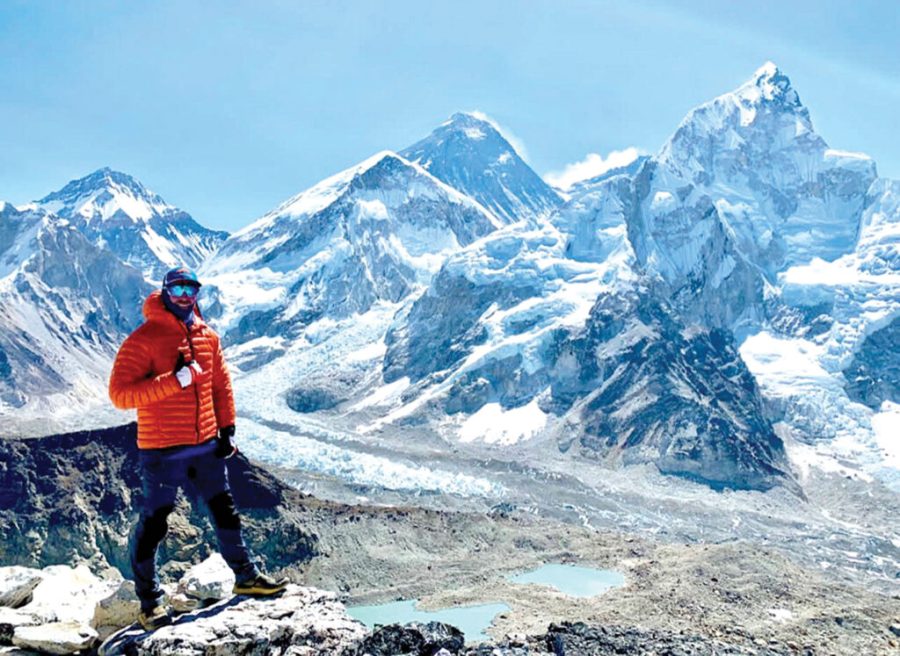

FORT CARSON, Colo. — For every two steps forward, Sgt. 1st Class Jason Howell pauses, catches his breath and continues the climb. Howell begins to hyperventilate, but he does not give up. Inching closer and closer to the summit, Howell’s body starts to give out and his vision fades…
2018 was the first time Howell ever saw the tallest mountain in the world, Mount Everest. Four years later, he would be making the ascent up to the highest point on Earth. Howell and his wife had taken a trip to Nepal completing the trek to the Everest Base Camp. He told himself if he ever got the opportunity to climb the 29,032-foot peak, he would, but not the conventional way.
“I would want to try it without supplemental oxygen because I want to test my physical capabilities, my technical proficiency, my physical fitness, my mental strength, fortitude and decision making,” said Howell. “I want to test myself as I am. Do I have what it takes to climb that mountain?”
Howell started his military career in 2003 by joining the United States Marine Corps. He took a break in service in 2009 and eventually joined the United States Army in 2012 where he became a Green Beret. He has been a mountaineering instructor at the Special Operations Mountain Warfare Training Center in Colorado for almost three years.
Howell trained for about a year and a half to prepare for one of the most dangerous expeditions in the world. He would wake up between 2 a.m. and 3 a.m. to run trails through the mountains. Working as a military mountaineering instructor helped with his physical fitness. Howell was continuously moving and working up in the mountains. The Sergeant would study Mount Everest by reading books, blogs, stories, and watching movies and documentaries. He wanted to know about everything and anything he might encounter on that treacherous mountain.
“Everything in my life was fully encompassed and devoted to that goal,” said Howell.
Despite all his training and preparation, Howell needed to factor in two critical variables.
“I have rheumatoid arthritis and Raynaud’s,” stated Howell. “If anything goes wrong at that altitude without the use of supplemental oxygen, there’s going to be consequences.”
Between traveling to Nepal, six weeks of climbing in below zero temperatures and traveling back home – Howell’s journey from start to finish would take about two months.
When the time finally came, Howell battled the ascent up Mount Everest without supplemental oxygen. Not wanting to hold back any of his teammates, he continued to push his body to the limit until it finally shut down.
“To achieve anything, you have to have that mentality, mindset and personality of ‘this is my goal, this is my objective, and I’m going to do whatever it takes to achieve this,'” said Howell.
Howell had been climbing throughout the night in limited visibility with only a headlamp for light. The harsh conditions of Everest were taking its toll. Barely conscious with a face full of snow, Howell began to realize the critical situation he now faced. He tried to focus, breathe and do what he needed to do: get to the summit and back down safely. To make it back home alive, Howell would need to use supplemental oxygen for the remainder of the climb.
“I had no idea how close to the South Summit I was,” stated Howell. “We continued for 15 minutes, and there I was.”
Howell’s determination to climb Mount Everest without using supplemental oxygen came short by just 200 vertical feet.
“Even though I successfully made it to the top of Mount Everest, my goal was to do it without supplemental oxygen,” stated Howel. “It was a battle for me to accept that, but the goal was to the summit, and the priority is always to come back home. And that’s exactly what I did.”
During the descent, the Sergeant remained a leader. Even while facing his own challenges, he ensured everyone in his group was healthy and accounted for.
“Lead by example, always lead from the front,” Howell stated. “Take care of your men, and they’ll take care of you.”
Howell shared that he is extremely grateful to have been granted permission by his chain of command and direct leadership for the opportunity to make this journey.
“It’s been tough for me not to focus on my failure or me failing my attempt without supplemental oxygen,” said Howell. “I definitely learned more about my body’s physiology, listening to my body and adjusting, especially at high altitude now moving in the mountains.”