
(COLORADO) — Satellite technology is one of the most important technologies that meteorologists use on a daily basis. In the world of weather, our satellites can help us identify areas of moisture, dry air, wildfires, severe weather and are also equipped to work with space weather. Satellites are extremely versatile and have multiple uses depending on the situation.
The National Oceanic and Atmospheric Administration (NOAA) rely on a specific series of weather satellites called “GOES”. This series consists of four satellites that watch our weather from above 24 hours a day, 7 days a week. These satellites orbit Earth about 22,000 miles above ground and are linked to the planet’s rotation. That means that they are travelling the same speed as Earth and are able to observe a specific region for complete coverage.
Courtesy: NASA
The GOES series’ latest satellite is denoted as “GOES-U” and will be the final installment of the four. Currently there are three other GOES satellites orbiting the Earth with specific purposes.
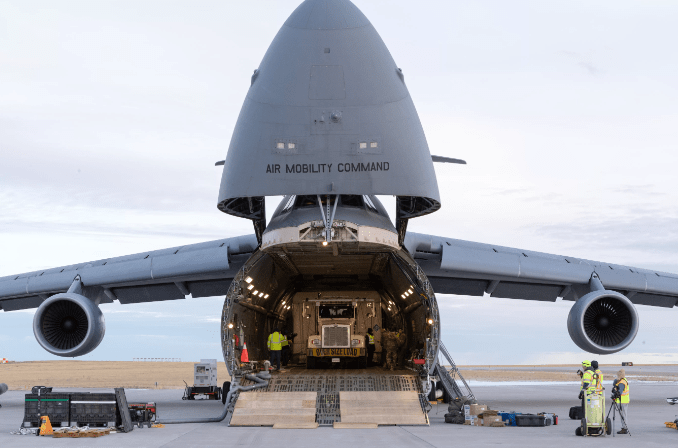
GOES-U was built at Lockheed Martin in Littleton, Colorado and left the facility just this week. It had to be carefully transported to Buckley Space Force Base in Aurora by an 18-wheeler. From there a C-5M Super Galaxy cargo transport flew the satellite to Kennedy Space Center in Florida.
Courtesy: NASA
Once the satellite undergoes tests and a variety of procedures to make sure that it is operationally ready, it’ll get the green light to head to space. Currently it is set to board a SpaceX Falcon Heavy rocket no earlier than April 30 of 2024.