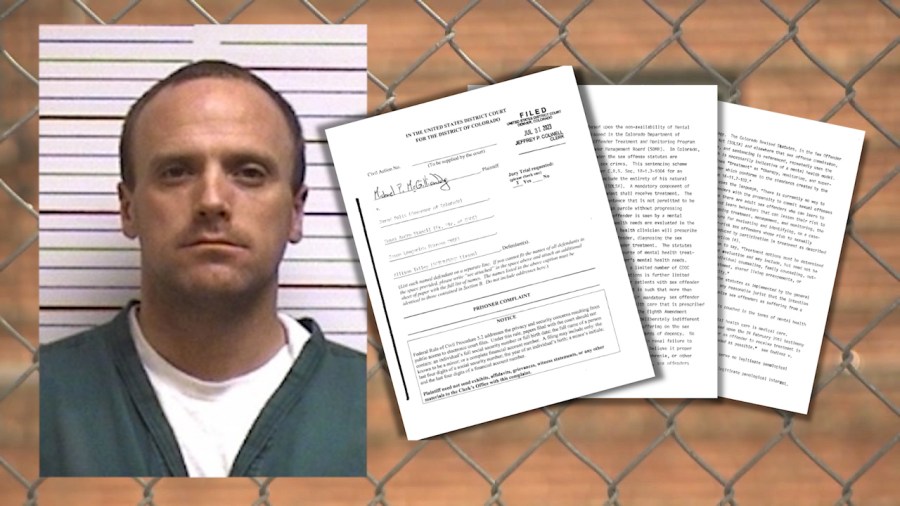

(BUENA VISTA, Colo.) — A lawsuit filed by an inmate at the Buena Vista Correctional Complex is accusing the Colorado Department of Corrections (CDOC) of denying him mental health treatment. This legal action prompted FOX21 to investigate the issue of mental health treatment for inmates, and whether all prisoners, regardless of their crimes, should have access to taxpayer-funded mental health services.
The plaintiff, Michael McGillicuddy, is serving a life sentence for sexually assaulting a minor under the age of 15. He specifically alleges that the CDOC has denied him access to the Sex Offender Treatment and Monitoring Program (SOTMP). The lawsuit, filed on July 31, calls for a policy change within CDOC to grant all sex offenders immediate access to SOTMP treatment.
He contends that this denial renders him ineligible for parole indefinitely. McGillicuddy claims this is a violation that falls under the Eighth Amendment’s proscription against cruel and unusual punishment.
This legal battle has emerged against the backdrop of a growing criminal justice advocacy movement in Southern Colorado. Most recently, on Aug. 5, a group protested outside of the El Paso County Criminal Justice Center, advocating for inmate’s rights to mental health treatment.
Rep. Regina English (HD-17), who was part of that protest, said that despite the seriousness of the convictions against McGillicuddy, inmates remain human beings.
“I hate that people inflict harm on innocent children. I don’t condone any of that. But, what I do condone is giving people the care and the help that they need to get better because these are obviously sick people,” said the South East Colorado Springs Representative.
Rep. English argues that mental health treatment for inmates is the solution to reducing recidivism: “For us to treat people so inhumanely and not allow them the treatment that they need, I just think that’s backwards. That’s why we have a revolving door of crime.”
FOX21 spoke with an inmate currently incarcerated at the El Paso County Criminal Justice Center, who revealed the debilitating effects of his untreated PTSD and depression.
“You got to think when you’re locked down for 32 hours at a time… emotionally, mentally, psychologically, it all eats away at you over time when you don’t get the help that you need,” said Derrick Bernard, who is charged with two attempted murders of law enforcement.
Bernard said he watches other inmates lose themselves to their mental illness and is advocating for therapy and doctors as a means for people to survive prison.
According to the arrest affidavit, McGillycuddy turned himself into detectives. In addition to the 2015 child sexual abuse crimes he committed, McGillicuddy admitted to sexually abusing this child six years prior to his arrest. This indicates that the oldest the child could have been, at the start of the abuse, was eight years old.
The documents also state that McGillicuddy was supposed to receive counseling for his issues in April 2014 but never attended. McGillicuddy said in the lawsuit that the lack of this mental health treatment is also a danger to others.
“Other prisoners are potential victims of the untreated sex offender. Prison staff and visitors are additional in harm’s way if the sex offender is not treated,” McGillicuddy said.
“A lawsuit? So he can get out and say, ‘Oh, I’m rehabilitated.’ No. He’s not going to be rehabilitated… They’re not worried about the victim. ‘Let me be the victim,’ that’s what they’re saying,” said Joanna Martinez, a survivor of child sexual abuse.
Martinez endured sexual abuse from her father for a decade, starting at the age of eight years old. She did speak out in favor of mental health treatment for criminals but stressed that the nature of the crime should matter.
“The only thing that a pedophile should get in prison is the electric chair… Because even the worst criminals don’t do that [commit sexual assault against a child]. They don’t deserve a second chance, they don’t deserve rehabilitation… They already took that for granted,” she stated emphatically.
Colorado law does acknowledge the distinction between those who can potentially rehabilitate and those who cannot. Adult sex offenders are granted treatment if they are deemed reliably lower-risk and unlikely to re-offend following treatment [CRS 16-11.7-103(4)(a)(I)].
The latest update on McGillicuddy’s lawsuit indicates that a judge issued an order on Aug. 1, giving him 30 days to address deficiencies in his motion, stating that failure to do so may result in the dismissal of the case without further notice. On Aug. 28, McGillicuddy issued a letter to the judge requesting a document, apologizing for any delinquency.
FOX21 reached out to the CDOC for comment, and they have yet to respond.