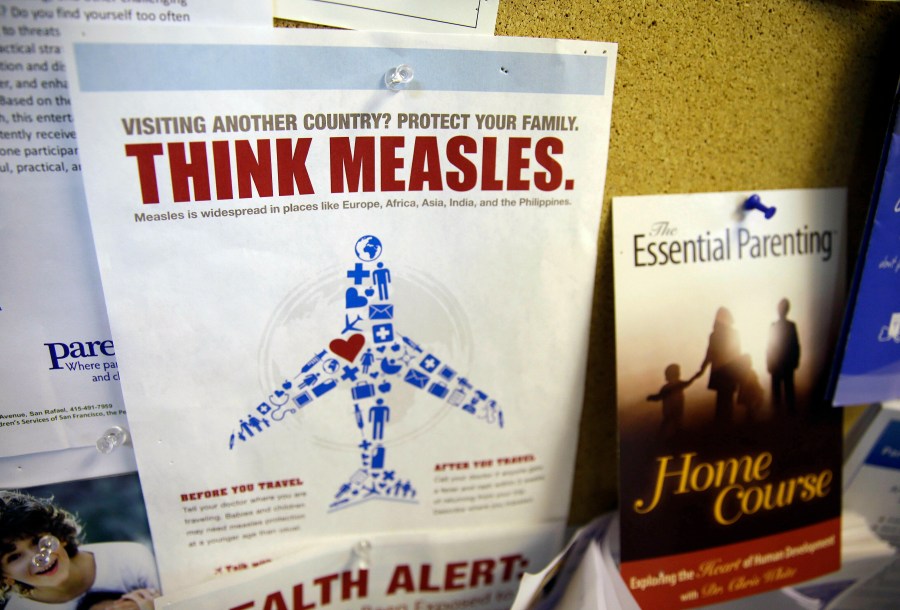

DENVER (KDVR) — Colorado health officials have confirmed an international traveler who arrived in Colorado on Dec. 13 has tested positive for measles.
The adolescent allegedly visited several Colorado counties. The last confirmed case of measles in a Colorado resident before this was in January 2019, according to the state.
According to the Colorado Department of Public Health and the Environment, Arapahoe County Public Health is leading the investigation and has been notifying people who may have been directly exposed.
CDPHE provided a timeline for the adolescent in Colorado.
On Dec. 13, the youth was at Denver International Airport from 4:30-8 p.m. with possible exposure to people moving through Concourse A, bridge security, baggage claim and the passenger pickup area.
On Monday, Dec. 18, the adolescent went to Children’s Hospital Colorado’s Emergency Department at the Anschutz Medical Campus from 8:30-11 a.m. The hospital is notifying healthcare providers, patients and others who were in a similar area as the measles patient.
What does this mean for Coloradans?
People who haven’t had the MMR (measles, mumps, rubella) vaccine are vulnerable to this infection because measles is highly contagious. The MMR vaccine given within 72 hours after exposure (but before symptoms are present) can prevent infection, according to CDPHE.
However, measles can cause complications, such as seizures, brain damage, ear infections, pneumonia and death.
Vaccination is highly effective against measles, and people who have previously been vaccinated with the MMR vaccine do not need to receive the vaccine again after exposure to measles. Coloradans can check their and their child’s vaccine status through an online database.
Measles spreads through the air and can remain in the air for up to two hours. Signs and symptoms of measles typically begin 7-14 days after exposure but may take up to 21 days to appear. A person with measles is contagious for four days before and four days after the rash appears.
Signs and symptoms include fever, cough, runny nose, and red, watery eyes, and the appearance of a rash at the hairline, spreading downward over the body, usually beginning 2-4 days after other symptoms.
Two doses of MMR are about 97% effective at preventing measles infection.
Centers for Disease Control and Prevention recommends children receive a first dose of MMR vaccine at 12-15 months of age and a second dose at 4-6 years of age. People who receive MMR vaccination according to the U.S. vaccination schedule are considered protected for life.