
COLORADO SPRINGS — In 2020, a majority of Coloradans voted for wolf reintroduction, which is now set to happen in December of 2023. That date is fast approaching, so Colorado Wolf and Wildlife Center held a talk Saturday afternoon to educate people on what they can expect for the reintroduction and why it could benefit the environment.
Colorado will soon see more wolves west of the Continental Divide. Credit: Rachel Saurer
In 1995, Yellowstone reintroduced wolves and Michelle Smith, volunteer for CWWC, said this is a good example of the reintroduction having a positive impact.
“They kept the deer and the elk off of vegetation. Had more trees growing, so willows, aspens in particular. And that brought back a lot of species like beavers, and once beavers came back we had additional species like fish and birds,” Smith said.
Smith said more wolves allows more vegetation to flourish by reducing the elk and deer population. Credit: Rachel Saurer
Although Smith highlighted the benefits of wolves on other animals, ranchers said the wolf introduction puts their livestock and livelihood at stake — especially since a calf was killed by wolves earlier this month.
“If you are raising cattle for your primary way to feed your family I can definitely see how people would be worried about wolves impacting their business. But, in other states we have been able to see that wolf predation is very low,” Smith said.
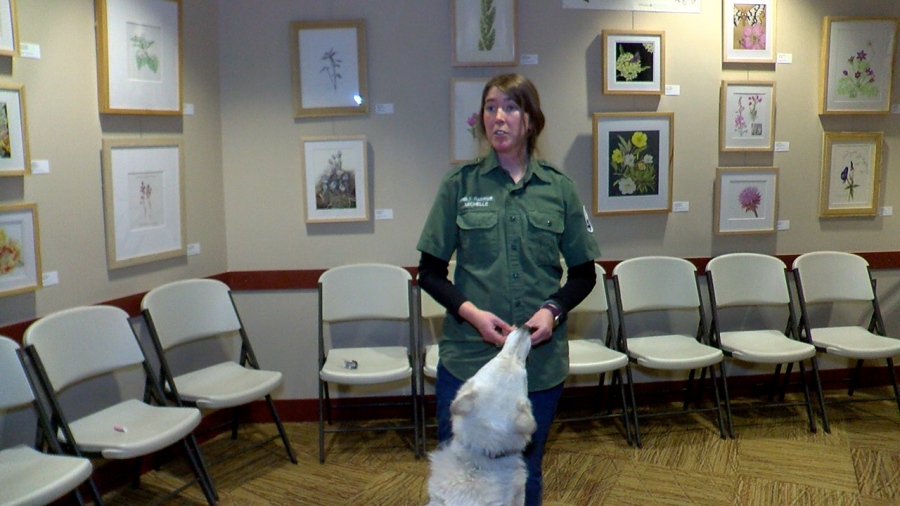
Michelle Smith, a CWWC volunteer, gave a talk at the Garden of the Gods visitor center with two ambassador wolf dogs. Credit: Rachel Saurer
Smith referred to data that said wolves attributed to 0.2 percent of all livestock death. But she also said she agreed raising livestock is not an easy job and any loss, large or small, can make a difference. So, the Colorado Parks and Wildlife has a program to help with the loss of livestock to large game.
“Bears, mountain lions and now wolves as well will result in compensation so if an animal is proven to be killed by any of those three big predators then the owner will get paid the market value for the animal that was lost,” Smith said.
To further protect yourself and livestock, Colorado Parks and Wildlife voted to allow hazing of Gray Wolves just this week. This means ranchers are able to use nonlethal deterrents against the animals who get too close.
Human presence is the best way to haze wolves, but Smith noted they are pretty easy to scare off. Credit: Rachel Saurer
“The most important thing when you haze wolves is to make sure that it is consistent and that you change it up because you don’t want them to get used to one thing in particular. Human presence is always going to be the number one deterrent,” Smith said.
Smith said hazing methods could include plastic strips along a fence, noisemakers, paint-balls or any other nonlethal method to scare them off.
Leading up to the date of the wolf reintroduction, CWWC said they will be holding a number of educational talks to keep Coloradans informed on how to coexist with the large carnivores.
If you would like to visit some wolves or offer support to the program by volunteering or donations, you can find more information on their website.