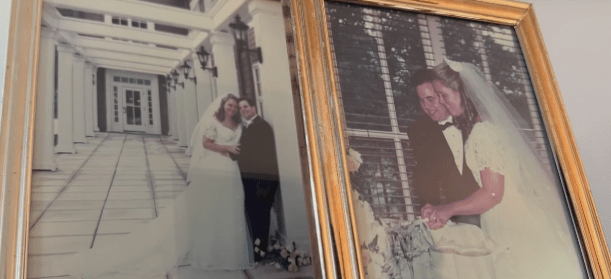

HARRISBURG, Pa. (WHTM) — Shawn Moyer couldn’t have predicted that Elena Hershey would have been his date a little more than a week before their prom 35 years ago, much less the person who would donate the kidney he badly needs and is getting Thursday morning.
But both of those things turned out to be true.
Moyer — now Dr. Shawn Moyer, University of Pittsburgh Medical Center’s chief quality officer, and still a practicing family physician — was, accurately enough, voted most likely to succeed in his Dallastown area high school senior class, where he was also student council president. But that wasn’t enough to stop the girl who was supposed to go with him from leaving him for “a better offer,” as he recalled.
Moyer needed a date. Hershey — a junior who couldn’t go to prom unless invited by a senior — was available.
“He needed a backup,” recalled Hershey, whom Moyer remembered as “smart,” “pretty” and a “remarkably nice person.” “And, you know, of course, I would love an invite to a prom. What girl wouldn’t? So, I was happy to go.”
Both recall the evening fondly. They had only been acquaintances, with mutual friends and siblings who knew the other better. They went off to college — he that year, she a year later — and lost touch.
Moyer needed a kidney transplant when he was 16 years old. He needed another one 20 years later (that’s common for transplanted kidneys). His wife, Alyssa, donated a kidney, which went to a stranger and qualified Moyer for priority on the transplant list through what was then (now 20 years ago) a novel “paired exchange program.” Unsurprisingly, 20 years later, he was back on dialysis and in need of a kidney, and Alyssa didn’t have another one to give.
Hershey, now living in Boulder, Colorado, heard from her good friend Julie, who is married to Moyer’s close childhood friend Kyle, that he needed a kidney. Once again, Hershey stepped in as Moyer’s backup.
As it happened, Hershey had already decided she would donate a kidney — altruistically and anonymously — to a stranger in need.
“So, I was glad I heard about [Moyer’s need] so that I could contact him and offer him my kidney,” Hershey said.
A good match for him as a prom date but not biologically as a living kidney donor, Hershey — as Alyssa had done two decades earlier — signed up to donate through a “paired exchange.” Back then, that meant concurrent operations — all donors and recipients at the same time. Nowadays, Hershey was able to donate her kidney in the summer of 2024. Julie, her close friend, even flew from Pennsylvania to Colorado for the operation to help Hershey and her husband after the surgery.
All that in exchange for the promise Moyer — who lives in the Glen Rock area of York County — would be prioritized for a transplant, likely within six months. Sure enough, he got the call last Friday.
“He texted me [the news], and I saw it, and I caught my breath a little bit, and I started to cry a little bit,” said Hershey.
Happy tears, of course, for Hershey, who is a teacher in Boulder.
“It’s just a remarkable thing for somebody to do,” Moyer said of Hershey’s donation, which, if all goes well, results in the kidney that will carry him the next 20 years, this time into his 70s.
But what Hershey wants everyone to know is, even if what she did was indeed “remarkable” by most people’s standards, the surgery and aftermath were rather unremarkable, in a good way.
“I started driving a couple of days later,” she said. “It was really no problem at all.”
Some discomfort lasted a week, she recalled. Hershey, a health fanatic, had to wait closer to a month before getting back on her bicycle and resuming other rigorous exercises, which she chalked up to a break she could use anyway.
“A few weeks of having to rest and a few days of discomfort to extend someone’s life or save someone’s life?” Hershey said. “It really is kind of a no-brainer.”
Without Hershey’s donation and the in-kind kidney Moyer is getting from another living donor, he would have had to wait years for a kidney from a deceased donor, with the inconvenience and risk that comes with remaining on dialysis for an extended time.
“So, it basically pays itself forward,” said Dr. Manish Gupta, a transplant surgeon at UPMC Harrisburg. “And it’s a great way of getting a kidney the fastest way possible when your intended donor is not a match with you.”