
(BOULDER, Colo.) — A new horned animal is making its debut at the University of Colorado Boulder (CU Boulder), and it’s not a buffalo. Think bigger, and millions of years older.
According to CU Boulder, a new exhibition featuring a full-sized skeletal reconstruction of a Triceratops dinosaur was unveiled by the CU Museum of Natural History in the lobby of the Sustainable, Energy and Environment Community (SEEC) building on East Campus on Tuesday, Jan. 16.
“This is an exciting time to expand the museum’s impacts, sharing research about our region’s ancient past and a sense of wonder about evolutionary innovation,” said the CU Museum of Natural History’s new director, Nancy J. Stevens. “This exhibition cultivates curiosity about the world around us, engaging the next generation to explore science, and encouraging reflection on environmental change through time.”
Triceratops were herbivores that roamed Colorado during the Cretaceous Period, around 68 to 66 million years ago. They were found throughout the west, from Colorado to western Canada.
The Triceratops exhibit represents the CU Museum of Natural History’s first dinosaur skeleton on display, ushering in a new chapter for the research institute. It measures 22 feet long and 9 feet wide. For comparison, an adult female bison usually measures around 7-10 feet long.
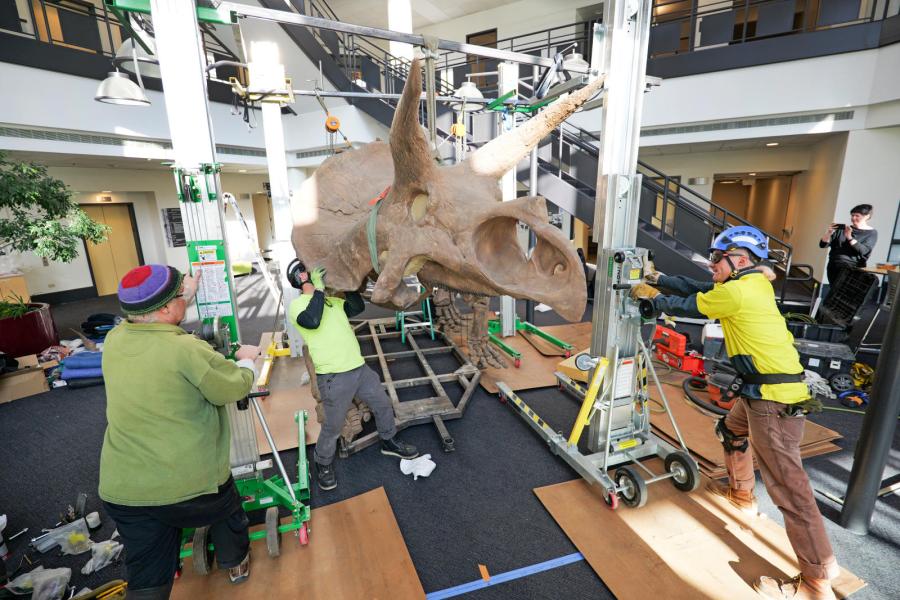
The university said the skeletal reconstruction is a composite of several partial Triceratops specimens found in Wyoming in the late 1800s. Scientists at the Smithsonian Museum first assembled these fossils into a single composite skeleton and displayed it in 1905. What stands inside SEEC’s lobby today is a high-resolution cast of that skeleton, made from plastic, fiberglass and foam.
“Museums want to exhibit complete skeletons, but the chances of finding a perfect, pristine skeleton of these kinds of animals are exceedingly small,” said Jaelyn Eberle, CU Museum curator of fossil vertebrates and professor of geological sciences.
The Triceratops first arrived in Boulder in 2022, carefully delivered by truck from Washington D.C. A crew painstakingly put it back together off site before delivering it to SEEC, where the body, limbs and skull had to be rolled through the doors separately.
Students, staff and members of the public can view the exhibit for free on weekdays from 7:30 a.m. – 5:30 p.m. SEEC is closed on weekends and holidays.