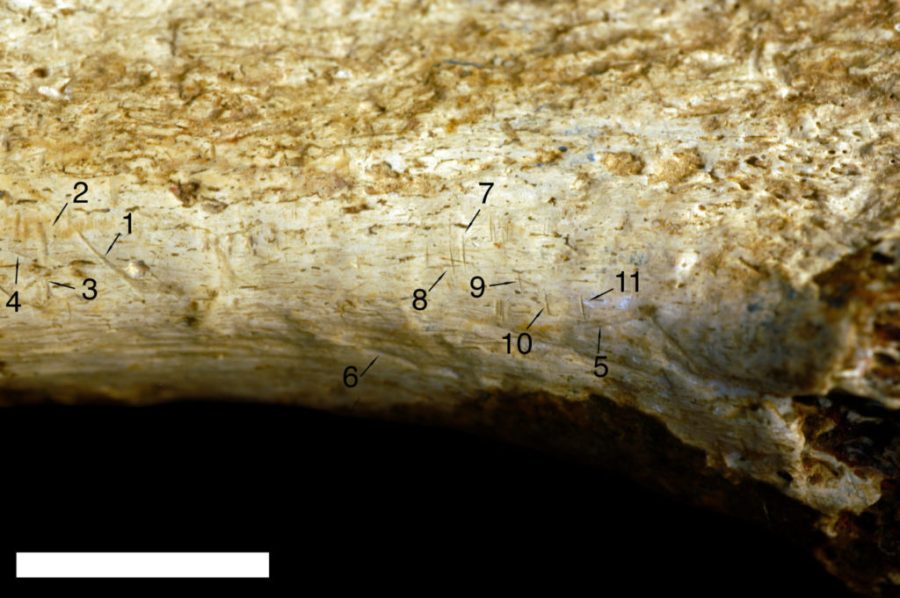

DENVER (KDVR) — Researchers from the Smithsonian National Museum of Natural History and Colorado State University have uncovered evidence of what might be the oldest known case of cannibalism.
They found cut marks on a 1.45-million-year-old shin bone from a relative of Homo sapiens in Kenya.
The study‘s author, Briana Pobiner, is a paleoanthropologist at the National Museum of Natural History. She discovered the tibia bone at a museum in Kenya when she was looking for bite marks or clues about prehistoric hunting and eating habits.
Instead, she noticed the marks that immediately looked like those on other animal fossils that were being processed for consumption, according to a release from CSU.
Evidence of butchery?
Pobiner used dental molding materials to send a copy of the bone to co-author Michael Pante, a professor of anthropology at CSU, so he could perform a 3D analysis of the fossil bone.
She did not give Pante details about what she sent but simply asked what made the marks. Pante compared precise scans of the molds with a database of tooth and butchery and trample marks.
Pante’s analysis found that nine of the 11 marks in question were a match for stone tool damage. The other two were likely bite marks, according to the release.
The marks were consistent with the defleshing marks on other animal fossils from the same area and time period, and were in a spot where several muscles attach, Pante said.
Evidence of cannibalism?
“The information we have tells us that hominins were likely eating other hominins at least 1.45 million years ago,” Pobiner said. “This fossil suggests that our species’ relatives were eating each other to survive further into the past than we recognized.”
However, cannibalism wasn’t the only explanation, even if it were a case of consumption. For it to be considered cannibalism, it would mean that both the eater and the eaten were of the same species.
Pante noted that there were more than one hominin species 1.45 million years ago, so it could have been a case of anthropophagism, which is the general consumption of human flesh.
While the evidence doesn’t directly suggest that cannibalism was at play, Pante said the marks were more likely evidence that a human relative inflicted the cuts and made a meal out of the leg rather than a ritual or defensive mark.