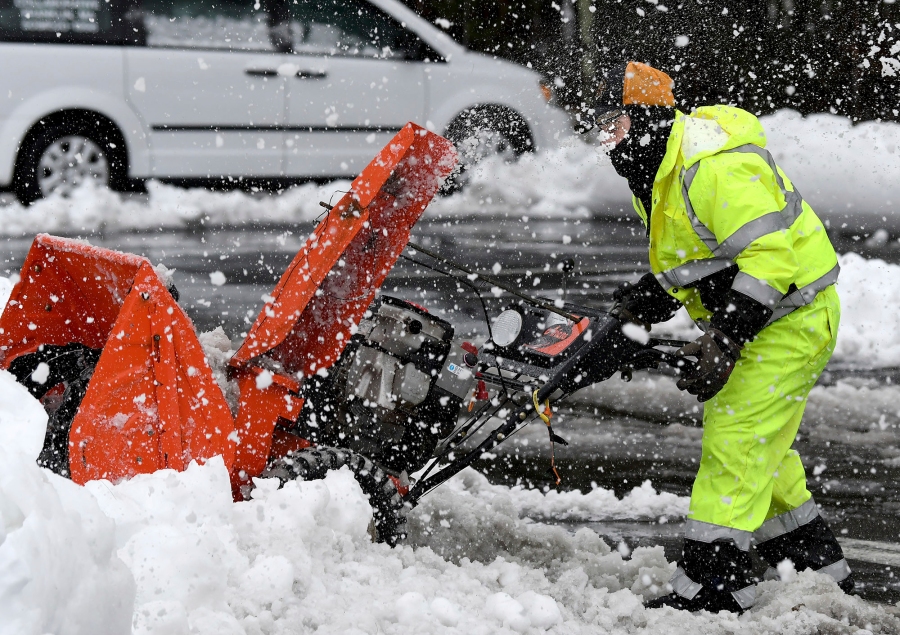

Today begins meteorological winter for Colorado and the northern hemisphere. December, January and February bring our coldest temps of the year, as the amount of energy from the sun bottoms out as the north pole tilts away from the sun and hours of daylight shorten.
While snowpack was above average as November began for most of the river basins in the state, numbers did not keep up, and by the end of the month snowpack was only at 60% of average state wide. The southwest corner of the state was under 40% of average.
While the numbers themselves tell a bleak story on their own, actually looking at the slopes tells a similar tale. Monarch Mountain Ski Area isn’t open as of this writing and is in need of more snow. Even at the top of some of the lifts there are still bare patches.
Images at the top of the Pioneer lift and the base of Monarch Mountain show the need for more snowpack. Images taken at 10:30 a.m. December 1st.
Colorado Springs and Denver along the Front Range are setting records for the latest first measurable snow. While parts of Colorado Springs had about a half inch of snow the day before Thanksgiving, the official climate station at the Colorado Springs airport only recorded a trace, which isn’t enough to measure. The first 0.1″ of snow will put an end to the extension of the record, which was set five years ago. Pueblo’s latest first measurable snow was on Christmas Eve in 1939…could that be in jeopardy?
The recent development of a La Niña in the Pacific Ocean suggests snow may continue to be tough to come by. A La Niña is the development of cooler than normal surface temperatures straddling the equator east of Central America and South America, and is part of an ebb and flow between warmer and cooler periods as part of the El Niño-Southern Oscillation (ENSO). Warmer water at the surface east of Central America and South America is called the El Niño phase.
La Niña produces a consistent area of sinking air in the Pacific Ocean off the coast of North America. This blocking high forces the polar jet stream to persistently be over the Gulf of Alaska before diving into the central plains of the United States.
This pattern tends to produce colder and wetter conditions than average over the northern plains, Great Lakes and northeast U.S. with drier than average conditions over the southwest. While there have been some La Niña years that break this pattern a little bit, if you were going to bet on how a La Niña winter was going to go – this is where you’d put your money (graphic below).
With a 90% chance that La Niña persists through the northern hemispheric winter of 2021-2022, the Climate Prediction Center forecast for December-February closely matches what we would expect to happen in a La Niña.
Here’s hoping that a few major storms are able to materialize at some point this winter as snowpack is very important for skiing, runoff, and water storage in reservoirs. Several significant storms over the Front Range and plains would be welcome too for agriculture and fire danger as drought has crept back in during the back half of the year. We need it!