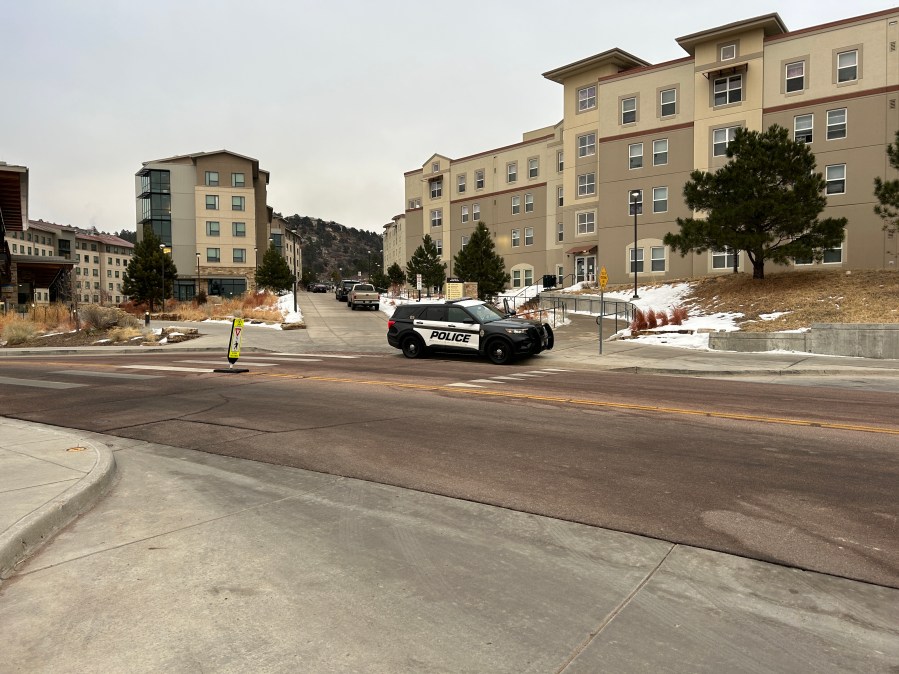

(COLORADO SPRINGS) — A newly released third-party review details the response by the University of Colorado Colorado Springs (UCCS) both before and after the deadly shooting at an on-campus apartment earlier this year.
The review was requested by UCCS Chancellor Jennifer Sobanet in March and was conducted by the law firm of Brownstein Hyatt Farber Schreck. “The Brownstein team was led by Jason Dunn, a former U.S. Attorney and Colorado Deputy Attorney General, and John Suthers, a former U.S. Attorney, Colorado Attorney General and 4th Judicial District Attorney,” according to UCCS.
According to the Executive Summary online, UCCS requested that the independent review include the following:
A review of campus response leading up to the incident.
Recommendations for any policy or process changes needed in regard to that response.
A review of campus response following the incident.
Recommendations for any policy or process changes needed in regard to that response.
The 91-page review details the documented interactions between 25-year-old Nicholas Jordan and UCCS officials for several months before the Feb. 16, 2024 shooting, where Jordan is accused of killing his roommate, 24-year-old Samuel Knopp, and 26-year-old Celie Montgomery. The report also delves into the alleged conflicts Knopp and another roommate had with Jordan before the shooting, along with what was done by UCCS to intervene, and the university’s after-incident response, including recommendations to improve.
Months leading up to Feb. 16, 2024 shooting
As described in the report, Jordan first enrolled at UCCS for the 2023 Fall semester and was initially renting an apartment off campus. According to documents, after informing UCCS in late October 2023 that he was “being evicted from his apartment for marijuana use and would be homeless,” a campus coordinator determined he had sufficient financial aid to cover campus housing.
Below is a timeline of events after Jordan moved into Crestone Unit #108, a four-bedroom on-campus apartment at UCCS.
Nov. 2, 2023: Sam Knopp and others living in Crestone Unit #108 were notified that Jordan would be moving in on an “emergency placement.”
Nov. 2, 2023: A Student Support Specialist emailed the UCCS Office of Institutional Equity “that a female student was citing sexual harassment as a reason for withdrawing from classes.” In a later email dated Nov. 13, 2023, it was indicated that the withdrawing student “had identified Jordan as the individual she claimed harassed her.”
Dec. 7, 2023: Jordan emailed a Residence Hall Manager reporting that he had “a bad roommate problem” and requested to move out to a “single efficiency apartment.”
Dec. 12, 2023: Jordan electronically submitted a “thank you” letter to the donor of his financial aid. According to the review, “the letter is nonsensical in tone and uses various words in odd and inappropriate contexts.” The letter was never forwarded to the donor and no one in the UCCS administration was alerted nor the Campus Assessment Response and Evaluation (CARE) Team “to the letter and its concerning syntax until after the shooting incident on Feb. 16, 2024,” according to documents.
Dec. 13, 2023: The Residence Hall Manager and Jordan met to discuss housing options, and the manager stated that “She would look into room change options and explained that to approve a room change there would need to be an ongoing conflict and mediation of the suitemates.” She went on to explain that Jordan was unable to articulate any examples of unfriendly, argumentative, or aggressive conduct of his suitemates.
Dec. 18, 2023: UCCS police responded to Crestone Unit #108 after resident hall employees reported a strong odor of marijuana coming from the room. Jordan “denied marijuana use despite smelling of marijuana himself,” and was told not to use marijuana in the residence hall.
Jan. 3-9, 2024: Knopp began submitting complaints to the Residence Hall Manager and the Assistant Director of Residence Life regarding Jordan. The complaints alleged that Jordan was smoking cigarettes, cigars, and marijuana in their unit, reported a woman who did not attend UCCS was living with Jordan and the two had “ruined their toilet” describing it as a “biohazard.” Knopp had requested to remain anonymous and that a resident advisor or police speak with Jordan and further stated that previous attempts to talk with him did not work.
Jan. 5, 2024: An incident report was filed by the Associate Director of Housing after UCCS custodial staff reported that a woman was seen in the unit without Jordan, that the toilet was overflowing and had soaked the carpets, and that Jordan’s room smelled strongly of marijuana and that a bag of trash “was emanating a strong odor.” The staff member indicated that they were concerned “the room was in severe violation of health policies.”
Jan 8, 2024: Two Resident Hall Managers visited the room and another incident report was filed. Jordan and the woman were informed of the guest policy, and the managers noted that a smoke alarm was taken off the ceiling. During this time, Jordan expressed interest in moving off campus and was walked through how to cancel the housing contract, according to documents.
Jan. 9, 2024: A UCCS officer responded to the unit to conduct a check and speak with Jordan. According to the review, Jordan was “quite defensive” and denied smoking marijuana in addition to the officer’s request to search his room. Knopp then joined the conversation and reiterated that “Jordan was smoking large amounts of marijuana and that the smell was driving him crazy.” Knopp was later texted by a resident assistant to contact UCCS police immediately should Jordan become verbally or physically violent. That same day, Jordan submitted a petition to cancel his housing contract, though it was not properly completed.
Jan. 10, 2024: Jordan met with the Assistant Director of Residence Life and a member of the Office of the Dean of Students to discuss the allegations. Later that day he sent an email to UCCS Housing that he was “severely requesting to commute and move into a different apartment.” The submitted petition was not properly filled out, so it was not forwarded to the independent committee for review.
Jan. 15, 2024: “Significant confrontation occurred between the Crestone Unit #108 residents that resulted in both UCCS staff and police being summoned to the unit.” Police spoke to Knopp who claimed he and another roommate were frustrated by Jordan’s resistance to clearing the common area and smoking marijuana. Knopp said he and the other roommate bagged all the trash in the common area and placed it in front of Jordan’s door. Knopp stated that Jordan was in a “fighting stance” and said, “You better watch your life.” According to police reports, all three roommates shared insults, and that the other roommate had to step between Jordan and Knopp. When Knopp was asked whether he felt safe in his room, Knopp responded: “Yes, school starts tomorrow and I really do not want to move.” According to the report, the other roommate confirmed Knopp’s recap and added that Jordan had threatened Knopp and said: “You better watch out. Snitching and consequences will cause more issues. Consequences will kill you.” Jordan denied threatening to kill Knopp and the officer stated to him, that if she received further complaints regarding threats it could elevate to a criminal act for which he could be arrested. Knopp also stated that “he did not recall that being said” when asked about Jordan’s threat to kill him. The officer later noted that the “complaint was unfounded.”
Jan. 17, 2024: UCCS staff conducted a meeting with Jordan who was found responsible for policy violations including; maintaining an unclean room and clogging his toilet. Jordan was given a formal reprimand.
Jan. 18, 2024: Jordan’s petition to move out was not done properly again, for the third time. A customer service specialist offered to meet with him to go over the petition.
Jan. 19, 2024: Jordan was informed via email that “the cause of his toilet clog was flushed condoms, and that he would be charged for the damages if it happened again.”
Jan. 24, 2024: Jordan met with UCCS officials about the petition process for canceling his housing contract and was told that “roommate conflicts… are not a reason to be let out of a housing contract.” During this meeting, Jordan mentioned that his brother passed away, and was told to reach out to the CARE Team or the Wellness Center if he needed support and was told to submit a petition under financial hardship regarding the housing request.
Jan. 25, 2024: The Resident Hall Manager offered Jordan a room change to a private unit, but he did not respond.
Jan. 29, 2024: Jordan emailed university officials that he was in Detroit and asked for a refund on the days he wasn’t living on campus. This was denied.
Feb. 5, 2024: Knopp and the other roommate’s request for a room change was accepted.
Feb. 7, 2024: Knopp emailed university staff and confirmed that he and the other roommate wanted to move and that, “As you guys are aware the situation with our roommate Nick [Jordan] is out of hand.”
Feb. 8-9, 2024: Knopp confirms the new housing assignment and that he would move in on Feb. 16, 2024.
Feb. 15, 2024: Jordan submits a request to withdraw from UCCS.
Feb. 16, 2024: Day of shooting
According to the review, in the early morning hours of Feb. 16, 2024, Jordan’s student key card access log showed that someone using his card entered the Crestone residence hall.
“Reports of the incident reflect that Jordan allegedly shot and killed Knopp and Montgomery in Knopp’s room. [The other roommate] reported having heard the gunshots from his room, hearing someone running away, and then calling the police.”
The report also revealed that “Jordan legally purchased the weapon in Detroit on or about Jan. 27, 2024.”
UCCS after-incident response
The report goes into further detail on how the university responded and alerted those on campus, detailing that UCCS police immediately sent out a message via the university’s emergency notification system, RAVE, that the campus was locked down and to shelter in place. Furthermore, UCCS police continued to release information from the Colorado Springs Police Department (CSPD) that was “safe and advisable” to share.
After the shooting, UCCS leadership met off campus at a space provided by El Paso County which acted as the university’s emergency operations center. There, leadership discussed ways to support the students on campus along with strategies for outreach, communication, and support for the surrounding community.
The report also goes into some criticism of UCCS for its after-incent response, in particular, statements that there was “no continuing threat to the campus” despite that Jordan was not arrested until the Monday after, on Feb. 19, 2024.
“As is often the case in the immediate aftermath of a serious crime, however, law enforcement conveyed information to campus leadership on the condition that it not publicly disseminate any information that would hinder the pending arrest or prosecution, or divulge investigatory techniques,” the report found.
Also detailed in the report were previous statements made by Arthur Simental, who resigned as the Director of Emergency Management at UCCS in July 2024. According to the report, in July, Simental “sent a complaint to the US Department of Education alleging violations of the Clery Act, which provides guidelines for academic institutions for preventing and responding to campus crime.” During an October 2024 interview with a media outlet, he described the UCCS response as “chaotic.”
While Simental declined to interview with the Brownstein Team, the law firm reached out to UCCS’s former Police Chief and Executive Director of Public Safety, DeWayne McCarver, who was also Simental’s immediate supervisor and was reportedly “complimentary of UCCS leadership’s after-incident response.”
According to the report, UCCS also conducted multiple campus emergency exercises between 2016 and 2020. It further detailed how after the pandemic, UCCS held a campus-wide lockdown drill on Jan. 28, 2022.
The review also explains that UCCS leadership acknowledged that “it would have been better prepared for the after-incident response had more frequent tabletop exercises and emergency drills been conducted closer in time to the shooting incident.”
The review also mentioned the establishment of the “Mountain Lion Team” immediately after the shooting, to “assure [the university’s] response to the tragedy was informed by a trauma-informed lens.”
UCCS leadership: How campus response could be improved
UCCS leadership identified several ways that the campus response could be improved through its own review. Below is a summarized list of findings in the report:
After the shooting, all housing staff should have remained on campus for resident students.
The university identified a need for more frequent tabletop exercises and emergency drills that need to incorporate campus-wide involvement.
There needs to be more training on the meaning of terms used in the campus emergency alert system, such as “lockdown” and “shelter in place.”
Communication from the UCCS Provost to faculty members about the reopening of campus and resuming classes “was not sufficiently clear and instructive.”
UCCS Executive Summary
In the Executive Summary provided by UCCS, it asked those looking at the report to note two key points, which are listed below:
While the review finds improvements the campus can and will make, it does not find that any individual at the university was responsible for a violation of policy or that anyone knowingly contributed to this tragic outcome.
UCCS strives to apply the highest standards of training and response to campus safety. Even with that effort, this report highlights how difficult it can be to distinguish between routine, persistent roommate conflicts and issues of a more dangerous nature. Roommate conflicts are not unusual on a college campus and are regularly resolved through education and mediation.
Recommendations made by the report
Below is a list of each recommendation made by the report, which can be read in full here.
UCCS should immediately improve its tracking of multiple reports of behaviors of concern from a single student.
UCCS should conduct a full review of its threat assessment protocol to ensure it is comprehensive and includes follow-up with students appropriately.
A representative from UCCS’s Counsel’s Office should be added to the CARE Team.
The CARE Team should document its discussions more thoroughly, particularly in cases where multiple behaviors of a single student are noted.
Given increasing demands for the critical function of the CARE Team, UCCS should ensure ongoing, appropriate support, including additional staffing.
UCCS should redouble its training efforts around reporting behaviors of concern to the CARE Team and should expand the groups engaged and trained to a broader array of campus units outside the traditional groups.
UCCS should immediately review its residence life and housing policies to reduce bureaucracy and ensure that serious incompatibility issues between roommates are more quickly identified and have a clearer and quicker path to resolution.
UCCS should increase its training for Resident Assistants (RAs).
UCCS should review and enhance training for housing staff to ensure that all staff have the tools to accurately track and report student behaviors of concern as well as to resolve conflict and conduct other needed monitoring and oversight.
UCCS should review its Emergency Operations Plan.
UCCS should assure continued open channels of communication with local law enforcement.
UCCS should conduct more frequent tabletop exercises to test emergency operations and responses.
UCCS should implement campus trainings on terminology used in emergency situations.
“Ultimately, this review found that there are ways in which the campus can improve processes and policies, as well as enhance existing trainings,” wrote UCCS. “Many of the recommendations have already been implemented or are in the process of being implemented, and all will be integrated into the university’s future plans.”
On Thursday, Dec. 5 at 1 p.m., UCCS held a Media Roundtable with Chancellor Jennifer Sobanet. FOX21 News Anchor/Reporter Austin Sack attended and will provide a recap of the discussion during FOX21’s evening newscasts on Thursday.