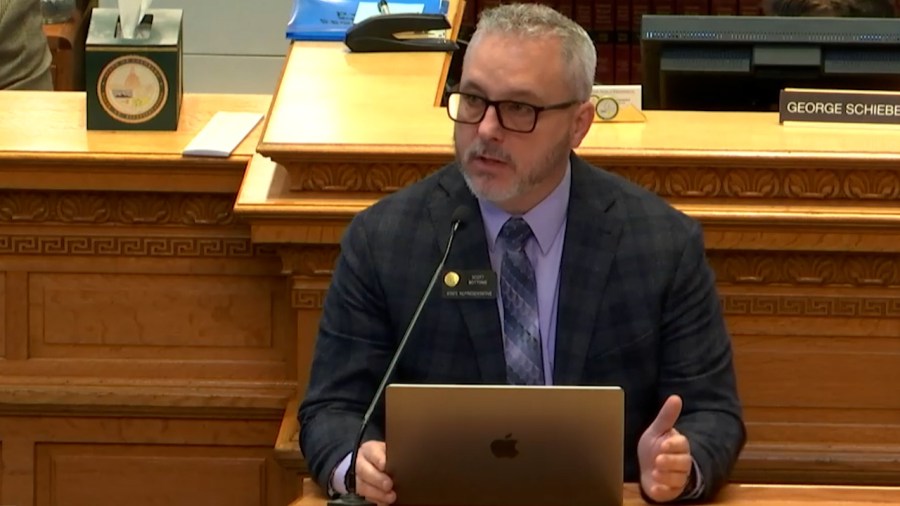

(DENVER, Colo.) — A proposed gender identity bill faced a setback in the State House after its sponsor sought to rename it in honor of a transgender woman who had inspired its creation. The attempt to amend the bill ignited a contentious debate among state representatives, leading to the removal of one Colorado Springs lawmaker from the well due to his remarks.
Currently, convicted felons cannot legally change their name unless there is “good cause.” HB24-1071, the Name Change to Conform with Gender Identity bill is aimed at adding gender identity as one of those reasons.
The sponsor of the bill, Rep. Lorena Garcia (D-Jefferson County), proposed an amendment to rename it as “Tiara’s Law,” paying homage to Tiara Kelley, a transgender woman who used to be a performer at Club Q.
Kelley has a criminal history as a sex worker in Florida, which landed her with a felony conviction.
Rep. Garcia emphasizes that the legislation had been informally dubbed ‘Tiara’s Law’ since its inception, underscoring its significance for individuals like Kelley who are unable to undergo a legal name change. Garcia also said Kelley has played a pivotal role as an advocate within the transgender community, particularly in Colorado Springs.
“Tiara is truly deserving of this… I am honored that she is giving us this gift of being able to have her name on this,” Rep. Garcia asserted at the hearing.
However, the proposed name-change amendment triggered a heated two-hour-long deliberation among lawmakers on Monday, Feb. 26. Opponents of the amendment argued that naming the bill after Kelley was inappropriate due to her criminal past.
During the deliberations, the House Speaker cautioned lawmakers against “dead-naming” Tiara, urging them not to use Kelley’s birthname or refer to her as a man. Nonetheless, Rep. Scott Bottoms from Colorado Springs defied this directive, prompting his removal from the podium by the Speaker.
In a conversation with FOX21, Bottoms persisted in using incorrect pronouns and defended his actions. He asserted his refusal to acknowledge what he termed as “deadnaming mentalities,” and claimed that the Speaker had no constitutional authority to force him to adhere to her directives.
Bottoms asserted to FOX21 that his defiance was intentional because he doesn’t believe in gender ideology. He said in response to her warning that he would be gavelled out if he persisted in using such language, Bottoms said, “then get ready.”
Several other Republican lawmakers raised objections to the bill’s proposed name change, without “deadnaming.”
Rep. Richard Holtorf, the Republican House Minority Whip (R-Yuma County), questioned the suitability of honoring someone with a felony conviction as the namesake of a legislative measure.
“I would support this bill 110% if it was a person that was respected, that was known and respected and wasn’t a criminal…We want high standards in this state… If you’re going to put somebody’s name on a bill, why wouldn’t you want that,” said Rep. Holtorf.
In response, Democratic lawmakers pointed to historical figures like Dr. Martin Luther King Jr., John Lewis, and Mahatma Gandhi, who had faced legal challenges, and were all arrested multiple times in their pursuit of justice. However, Republicans countered, asserting that Kelley’s criminal charges differed significantly from those of civil rights leaders.
“We’ll be listed down that we are going to glorify and hold up a convicted criminal,” said Rep. Anthony Hartsook (R- Douglas County)
The proposed amendment was ultimately voted down, 31-28, as ten Democrats sided with Republicans against it.