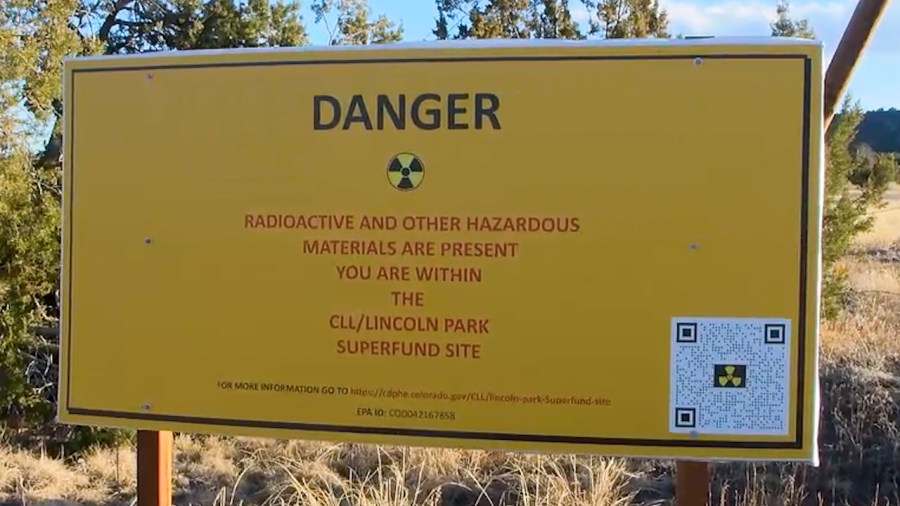

(CAÑON CITY, Colo.) — The Colorado Legacy Land/Lincoln Park Superfund site, formerly known as the Cotter Uranium Mill, closed in 2011, but more than five million tons of toxic waste remain at the 2,600-acre site unresolved. A local non-profit continues to raise awareness in the community and is asking federal agencies to take over cleanup operations.
The site consists of a uranium process mill located adjacent to the unincorporated community of Lincoln Park, approximately two miles south of Cañon City. The entire site is within Fremont County. The Colorado Department of Public Health and Environment(CDPHE) reports mill operations have released radioactive materials and metals into the environment. These releases contaminated soil and groundwater around the mill and the Lincoln Park area.
“The superfund site is one of the most contaminated and dangerous places on the planet, and this one has been that for 40 years,” Jeri Fry, Co-chair of Colorado Citizens Against Toxic Waste(CCAT) explained. “This is something you can’t gloss over, and it’s one of the things that we’re trying to be sure the regulators bear in mind as they try to do the remedial investigation. The remedial investigation is simply the first step of the super fund process.”
The CDPHE is the lead agency overseeing the site’s activities with the Environmental Protection Agency(EPA) acting as the support agency.
Near the end of January, the nonprofit formally requested the EPA take over the work at the Cotter site. While they await a response, hopes for a prompt solution remain low.
“A request like this from citizens from an established group is not to be taken lightly, and that’s possibly why we haven’t heard from the EPA yet, because they’re going to have to kind of take a step back and say, okay, now what do we do?” Fry said. “They’re having to take that step back right at the beginning of a new administration that we have seen the last time around gutted the EPA.”
The Cotter/Lincoln Park Site was added to the EPA’s National Priorities List in 1984 (making it a Superfund site). For administrative purposes, the site is divided into three operable units (OUs):
OU1 – The sources of contamination on the mill site, such as the Old Ponds Area.
OU2 – The Lincoln Park neighborhood (off-site impacts).
OU3 – Other areas near the mill where there has been a release or threat of release of hazardous substances from the mill.
Cleanup activities to date have focused on eliminating the mill site as a source of contamination in Lincoln Park and eliminating exposures to Lincoln Park residents.
Courtesy of Colorado Department of Public Health and Environment
The EPA reports during the operation of the former alkaline leach mill, liquid wastes containing radionuclides and heavy metals were discharged into 11 impoundments, now known as the Old Ponds Area. Mill and impoundment operations resulted in environmental contamination. Additionally, a flood in June 1965 caused the impoundments in the Old Ponds Area to overflow into Sand Creek, which flows from the mill area north toward the residential area of Lincoln Park.
Cotter also was producing yellowcake at the Cañon City mill. Yellowcake is the solid form of mixed uranium oxide, which is produced from uranium ore in the uranium milling process. In addition to producing yellowcake, the mill produced vanadium and molybdenum as byproducts. Historical mill operations and disposal practices released radioactive and metal contamination into the environment.
One of the most concerning issues is the release of radioactive materials and heavy metals into the Old Ponds Area, as well as several impoundments, causing environmental damage that still affects the neighboring community of Lincoln Park today.
“I have seen a lot of people get all kinds of different cancers, both defects, inexplicable immune system problems,” Carol Dunn, Co-chair of CCAT said. “Radioactivity is one problem, but then the heavy metals associated with that got into the groundwater can cause kidney problems, thyroid problems, a myriad of health issues.”
CCAT tells FOX21 News the community of Lincoln Park has waiting long enough and it’s time to ensure the site is fully cleaned up and restored to a safe and healthy condition.
“That’s why we’ve asked the EPA to step in,” Fry explained. “We need to educate ourselves, and we need to understand that this is that long-lived and will require that kind of respect and care so that our grandkids, great-grandkids, great great-great-grandkids are healthy because this stuff messes with the genetic library.”
The CCAT holds frequent community meetings. For more information visit their website or Facebook.
What Is the current site status?
The EPA reports an Administrative Settlement and Order on Consent for a Remedial Investigation/Feasibility Study that took effect on December 9, 2014. This document is also known as the 2014 Remedial Investigations/Feasibility Study Settlement Agreement. It sets out Cotter Cooperation’s legal obligation to conduct a Remedial Investigation/Feasibility Study (RI/FS) in accordance with CERCLA, commonly known as Superfund.
Per this agreement, the Lincoln Park Superfund site entered the RI/FS phase of the Superfund process. RI/FS will determine the nature and extent of contamination at the site, identify technologies available to address this type of contamination, and evaluate the performance of technologies that may be used to clean up the site. Several investigations and response actions have occurred at the site under CERCLA, the Radioactive Materials License, and the 1988 Consent Decree and Remedial Action Plan. Therefore, the RI will include an evaluation of existing data, which will be subject to data quality verification and will identify data gaps, if any. If necessary, additional data collection will be performed to characterize the nature and extent of contamination at the site.