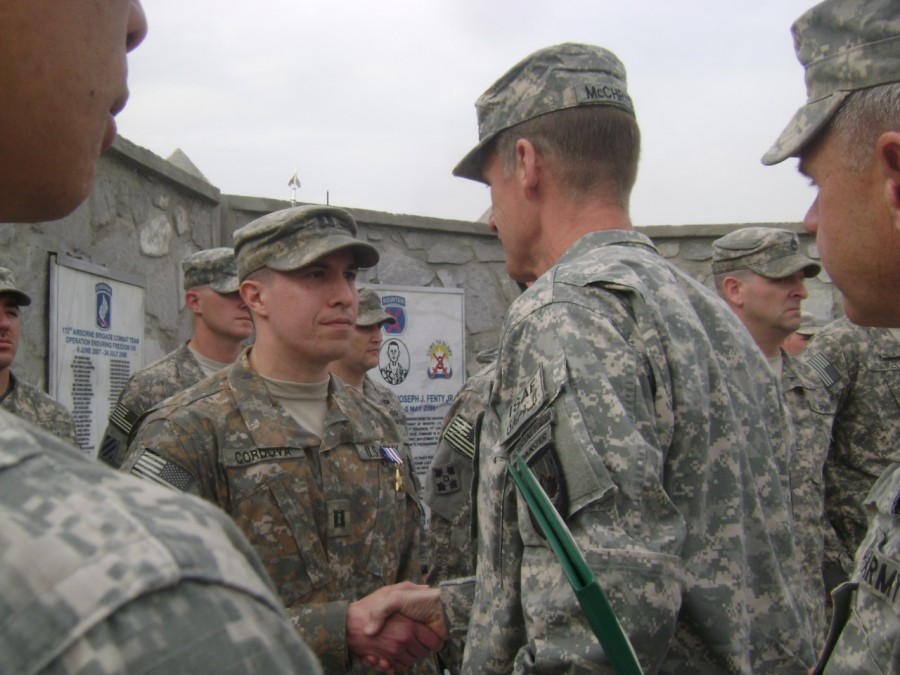

(CAÑON CITY, Colo.) — Located at the bottom of a remote valley in a war-torn country, a small military outpost would forever change the standard for military medical protocol and save countless lives for years to come. But, not without the sacrifice of eight courageous soldiers.
On Oct. 3, 2009, Senior Medical Officer, Chris Cordova along with approximately 50 other soldiers awoke to what would be the bloodiest battle between American troops and the Taliban.
At 6 a.m., a group of about 450 Taliban enemy fighters descended on Combat Outpost Keating located in the Nuristan province of northern Afghanistan. Cordova witnessed the death of his soldiers firsthand as he rushed to save as many lives as possible while under enemy fire. Among those Cordova desperately fought to save, was the life of one of his closest comrades, Stephan Lee Mace.
“We had an enemy that was on our base. Buildings were on fire. We weren’t evacuating the soldier for a while,” said Cordova. “So instead of just watching him sit there and die, I just thought of things that we could do.”
Cordova, two other medics, and additional soldiers would draw blood from themselves to perform a total of five whole blood transfusions on the dying soldier. Whole blood transfusions were not very common at the time, according to Cordova.
Soldier Mace would get 16 more precious hours of life before he was transported to a medical evacuation helicopter for surgery. It was a miracle and a small victory – enough for Cordova to be somewhat confident that Mace would make it. Cordova wanted to believe his friend would come out alive.
“Later on when I got the news, it was pretty devastating. Definitely, had to go to kind of a quiet spot and just kind of reflect on, you know, what we could have done differently,” Cordova stated. “After all we did, how could he still not make it? It was tough.”
Soldier Mace wasn’t able to make it home, but nine years later, Cordova would see how he and his soldiers changed military policy nearly a decade after the attack on COP Keating.
While overseeing care on his last deployment, every aid station situated throughout seven provinces in Afghanistan would explain the military’s new whole blood transfusion protocol to Cordova, not having any idea that he and the heroic actions of his comrades were what created the standard in the first place.
“They’re like, ‘Hey, sir, we want to show you our, you know, whole blood transfusion protocol,’ not knowing… that I had anything to do with this back in 2009. Here I am in 2018 in Afghanistan… people are prepared and proud of their protocol,” Cordova says.
Cordova had the procedure published in the Journal of Special Operations Medicine, which helped set a new precedent for military medical practices.
In 2010, Cordova would become a Silver Star recipient for his heroism. A book and two Hollywood movies later based on the events of COP Keating, Cordova still remains too humble to boast of his historic achievements.
Cordova’s story remained somewhat inconspicuous in the local communities of Southern Colorado. He said it’s because of survivor’s guilt and traumas that he faces day to day.
Read more about what retired army medic, Cordova, is doing now to help the soldiers that did make it home in Part II.