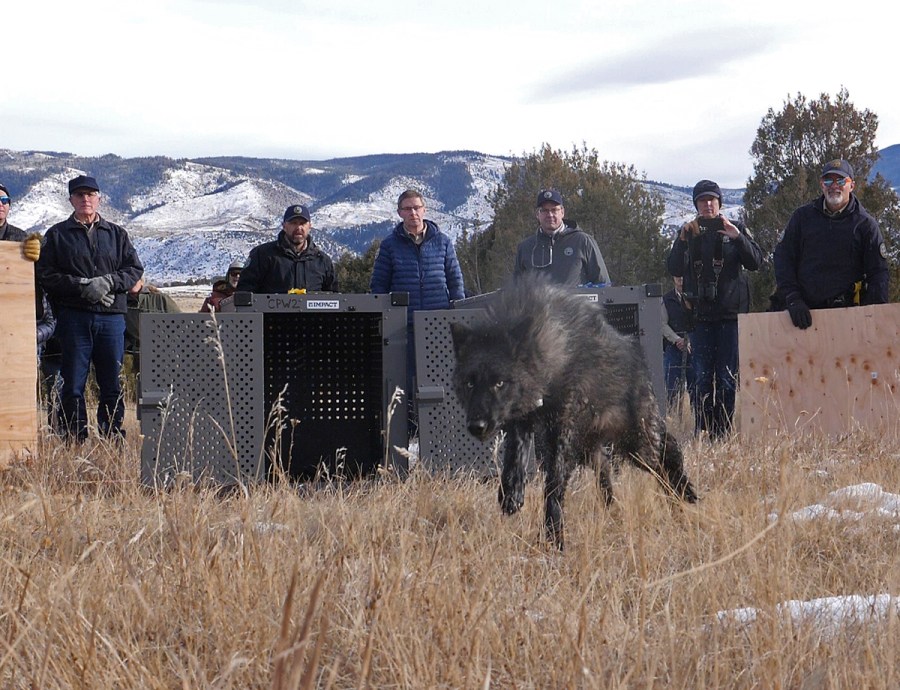

DENVER (KDVR) — The Grand County Sheriff joined ranchers and stock growers of Grand, Jackson and Larimer Counties in calling on Gov. Jared Polis and Colorado Parks and Wildlife to remove wolves behind recent cattle killings.
The groups are concerned that the 10 new wolves reintroduced under a voter-approved mandate are a threat to their livelihoods after a string of five Grand County depredations. Depredations refers to an act of preying upon or robbery from someone. CPW also confirmed a calf was killed in Jackson County this month.
The stock growers are pointing to various information included in the Colorado Wolf Restoration and Management Plan that says wolves with a history of chronic depredation should not be translocated and should also not be sourced from areas with chronic depredations.
“Constant and chronic depredation of animals ranging from cows and calves to sheep and
even family dogs has been ongoing for over two years at this point and CPW has made no
measurable effort to support ranchers or manage conflict wolves,” said the Larimer County Stock Growers Association in its letter to the Colorado Wildlife Commission.
Sheriff calls depredations a matter of ‘public safety’
Lethal deterrents are illegal. According to CPW’s website, a depredation must be confirmed before CPW will allow a rancher to take lethal action against a wolf.
Grand County Sheriff Brett Schroetlin also wrote to the state asking for relief.
“It is my duty as the County Sheriff to prioritize Public Safety and to address a safety lapse when I feel that we are falling short,” he wrote. “In this case, we have a clear Public Safety concern, couple with increased concerns over private property rights and it is our obligation as leaders to do the right thing, even when the right thing isn’t always the easiest solution.”
Schroetlin requested that CPW or U.S. Fish and Wildlife Service “lethally remove” the two wolves allegedly killing the five calves in Grand County.
“Without this immediate action, you are ultimately failing the great citizens of this country; many of whom are multi-generational ranching families and businesses, and setting poor precedence for further encounters in Grand County and most likely other areas in our region that will soon be following suit,” Schroetlin said.
Stock growers groups speak out
The association claimed that there are eight counties where collared wolves have been recorded on CPW’s watershed map. The group also alleged that seven of those counties were opposed to the state ballot measure on wolf reintroduction by margins of 53-88%.
The association also stated that these counties have over 130,000 head of cattle or 5% of the state’s total livestock populations. The group said these counties’ livestock production provides over $158 million in economic impact to the state.
On the other hand, the association declared, the total cattle numbers for the 13 counties that voted in favor of wolf reintroduction are about 141,000 or 5.4% of the state’s livestock population.
“It seems only natural that communication would be of utmost importance to the communities who are the most adversely affected,” the Larimer County Stock Growers said. “Yet the opposite is becoming truer with each passing day. CPW has the technology to track reintroduced wolves in real time and, rather than give proactive information to ranchers and residents alike in direct vicinity of collared wolves, you are choosing to release vague locations days and weeks after the fact. This is leading to increased wolf-livestock conflict and further alienating those that should be your partners in conservation.”
The Middle Park Stockgrowers also sent a letter to the state, noting that Grand County producers have “diligently” implemented a “comprehensive suite of non-lethal deterrents,” which include fox lights, maintaining a presence near cattle throughout the night, implementing carcass management strategies and utilizing cracker shells.
Colorado Governor’s Office responds
In a statement sent late Monday night, a spokesperson from the Colorado Governor’s Office said lethal control of wolves when only 12 are in the state is “premature.”
“It is widely known that wolves are opportunistic hunters and Colorado voters were fully aware of the diet of wolves and made the decision to reintroduce wolves. Now CPW and CDA will work with ranchers on how to successfully and non-lethally deter predation, as is being done successfully in many other states that have both vibrant and successful ranching sectors and a much larger population of wolves than Colorado,” the spokesperson said.
The state reimburses confirmed wolf-caused depredations on cattle, up to $15,000 per loss. The spokesperson added that the state has established a dedicated Wolf Depredation Compensation cash fund of $175,000, provided from the state’s general fund. The compensation fund will receive an additional $350,000 per fiscal year to keep a healthy balance in the fund on an ongoing basis.
CPW has spending authority for up to $175,000 in the current fiscal year from this fund to compensate livestock owners for wolf depredation. CPW also requested increased ongoing spending authority of up to $525,000 per year beginning in the next fiscal year, which is currently being considered by the General Assembly as part of the Long Bill which will be signed into law.
“The Colorado Department of Agriculture and CPW continue to work with the Middle Park Stockgrowers and the Grand County community on a plan that would help employ non-lethal deterrent tactics, such as range riders,” the governor’s office spokesperson said. “While the department’s budget request to the legislature for scaling up range riders is pending at the legislature and will likely be signed next week, CDA and CPW are deploying available resources to provide immediate support and are working on a plan to deploy on-the-ground assistance through range riders this month.”
The state has plans to introduce more wolves between December and March 2025, intending to release between 30-50 wolves in the next five years.