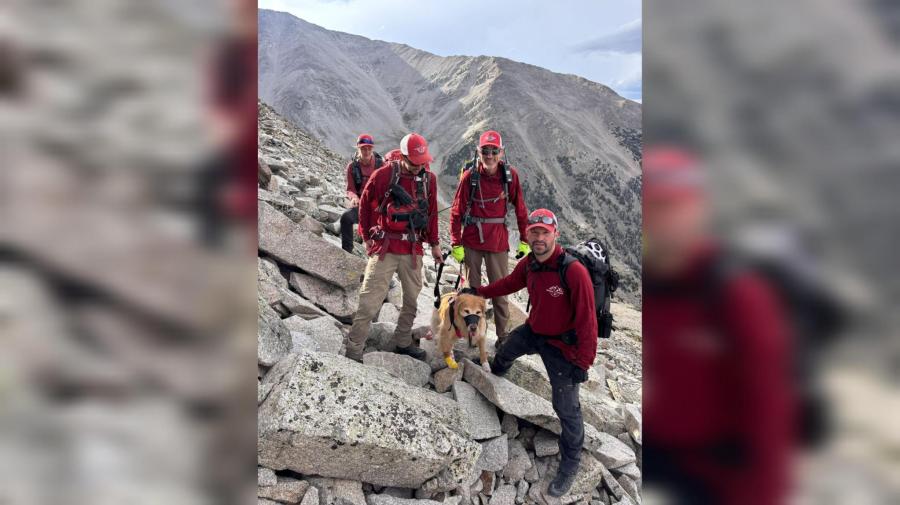

(CHAFFEE COUNTY, Colo.) — The Chaffee County Search And Rescue North (CCSARN) team rescued a tuckered pup with painful paws from a Mount Princeton hike on Thursday, Sept. 4.
According to CCSARN, the call came in around 2:38 p.m. and teams reached the dog around 4:36 p.m. The dog was tired and its paws needed first aid, though it didn’t like the rescuers touching its paws to help out.
According to CCSARN, rescuers put a soft muzzle on the dog to prevent bites while they treated the dog and started to help it down the mountain in a dog rescue sling. The muzzle came off as soon as the dog felt a little better, and it was safe to remove it. Everyone was safely down the mountainside by 6:15 p.m.
CCSARN stated that human rescues are prioritized throughout the state, and not all rescue teams will perform dog rescues, as funding and staff availability don’t always allow for them. However, CCSARN acknowledges that a pet emergency can quickly escalate into a human emergency when hikers fail to bring sufficient supplies for themselves and their pets, or adverse weather conditions are approaching.
Park County Search and Rescue shared tips on how to hike with your dog safely, saying that heading to the backcountry with your four-legged companion takes extra preparation. Extended wilderness miles are different than long walks around your neighborhood. Those planning on hiking with their pup should bring:
Plenty of water: Just like humans need to bring extra water for themselves when hiking, your dog needs a separate supply brought just for them.
Food: Extra food and treats will give your dog the energy it needs for the hike.
Bowl: It’s easier for your dog to get the food and water it needs when it can drink out of a bowl, instead of off the ground or from a water bottle.
Paw protection: The terrain in the mountains can be rough, too hot, or too cold, and booties can protect your pet’s paws.
Dog First-Aid Kit: In case of a cut or paw injury, you should check your dog’s paws often.
Emergency-evac Harness: There are various emergency dog harnesses, such as Fido-Pro, so you can carry your dog out safely without having to worry about whether emergency crews can get to you.
The most important preparation you can make for your dog’s safety is to evaluate whether your dog should really do the hike. Is your planned distance, terrain, and elevation appropriate for your dog’s current fitness level? And is the terrain realistically safe for dogs?
According to CCSARN, statistics show that Mount Princeton is not dog-friendly, as the terrain is too rough for their paws. This was the sixth pet rescue they have performed so far this year, and all have been from Mount Princeton.