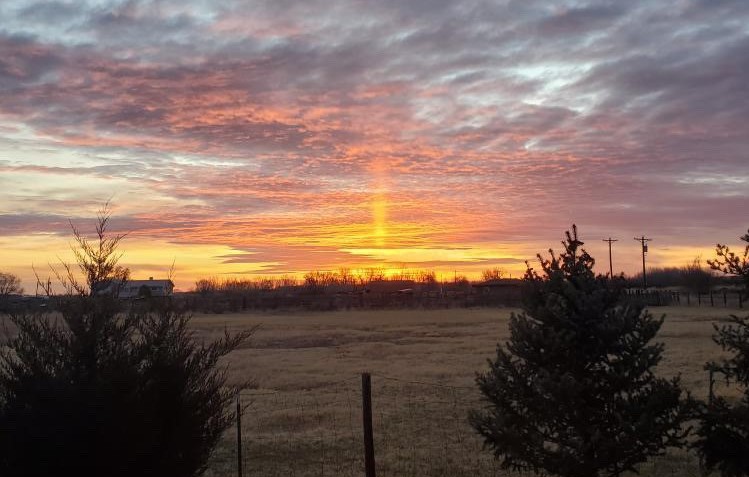

Stephanie Reger was up with the sun on the morning of March 30, 2021 and caught a solar pillar just prior to the sun coming up above the eastern horizon. What a stunning shot behind a departing storm!
Have you ever seen a solar pillar? If so, did you know its name? A similar feature can also occur at night in really cold, often arctic airmasses, when lights from buildings.
A solar pillar appears as a shaft of light extending vertically above the sun, most often at sunrise or sundown. They develop as a result of ice crystals slowly falling through the air, reflecting the sun’s rays off of them. Look for sun pillars when the sun is low on the horizon, and cirrus clouds are present.
Reflection of light occurs when the light waves encounter a surface or other boundary that does not absorb the energy of the radiation and bounces the waves away from the surface. The light is not separated into its component colors because it is not being “bent” (or refracted), and all wavelengths are being reflected at equal angles.
If ice crystals are oriented parallel to each other as they fall, refracted rays combine to produce intense bright spots on either side of the Sun called sun dogs. They are located approximately 22 degrees either left, right, or both, from the sun, depending on where the ice crystals are present. The colors usually go from red closest to the sun, out to blue on the outside of the sundog. Sundogs are also known as mock suns or parhelia, which means “with the sun”.
Sundogs are colored spots of light that develop due to the refraction of light through ice crystals. They are located approximately 22 degrees either left, right, or both, from the sun, depending on where the ice crystals are present. The colors usually go from red closest to the sun, out to blue on the outside of the sundog. Sundogs are also known as mock suns or parhelia, which means “with the sun”.
Refraction is the change in direction of a wave (in this case light) due to a change in its speed. This is most commonly observed when a wave passes from one medium to another at any angle other than 90° or 0°. So, when light is refracted inside a an ice crystal or water droplet in the air, its broken into its component colors. This creates the rainbow effect.
Occasionally, when conditions are right, with both supercooled droplets (below freezing but still liquid) and when different shapes of ice crystals are present reflection and refraction all happen at once and a number of phenomena occur at the same time!