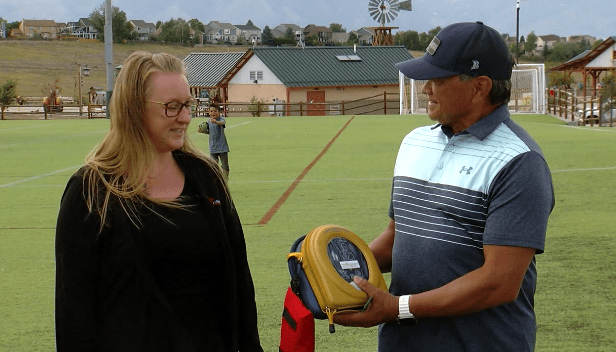

(COLORADO SPRINGS) — On Sunday, Sept. 15, a man who survived cardiac arrest donated an AED machine to a local youth football league, to show his gratitude to the community members who saved his life.
Sudden cardiac arrest is a life-threatening emergency that causes the heart to stop beating. Only one in 10 survives, but training on CPR and AEDs can increase survival rates by 50% in every 10 cases. “Don’t rely solely on EMS before you do something, and be a hero,” said Erin Lea Smith with AED Everywhere.
For John Aguon, Briargate YMCA was his haven, a place where he could unwind and release any stress from the day. However, on Jan. 22, his life forever changed when he fell to the ground, having experienced a sudden cardiac arrest.
“That afternoon, I was working, playing basketball, shooting around, kind of enjoying my day and I went into total cardiac arrest. I literally fell on my face, and everything went dark from there,” said Aguon.
Since his recovery, the medical directors for AED Everywhere honored him by donating an AED device, which he decided to pay forward to the Elite Youth Football League in Colorado Springs.
“This is just a true honor and a blessing to have this in our organization. Not only can it help our team, but it could help somebody in the stands at any time, and it’s just an honor to have it,” said Lucas Quintana, President and Coach of 13U Colorado Springs Elite Football.
Augon said everyone should have one of these machines available, yet many people do not.
“You just never know in life; things happen and I never thought it would happen to me and it happened to me. It can happen to anybody, and it’s a young person that it can happen to,” added Augon.
On Sunday, AED medical directors took the time to train parents and coaches on how to use the device. “It’s not a bad idea. Wherever you go to kind of make yourself aware of where that aid might be residing,” said Dr. Lenard Zemel with AED Everywhere.
Dr. Zemel said many people choose not to use AEDs because they lack the training. “What can happen is the AED not only delivers a shock if it’s needed, but it’s also capable of actually reading the EKG. So, if it’s not appropriate to deliver a shock, it won’t,” added Dr. Zemel.
More than 350,000 cardiac arrests happen outside of hospitals every year. A cardiac arrest happens when the heart stops beating normally, the pulse disappears, and a person stops breathing.
“If you’re just waiting for 911 to get there, that could be five, that could be seven minutes and that could be five to seven minutes of your brain that you just lost because nobody did CPR on you and nobody used a defibrillator,” added Smith.
Augon said he is forever grateful for the people who saved his life and is hoping to help someone else through his donation.
“There’s absolutely a new perspective. I’m very grateful for it, as I enjoy each and every day, I guess each and every heartbeat now. I’m excited to be able to live life to its fullest,” said Aguon.
Sudden cardiac arrest is a national public health crisis that strikes people of all ages who may seem healthy, including children and teens. Symptoms include sudden collapse and shortness of breath. If someone you know ever experiences this call 911 immediately, begin CPR, and administer an AED.