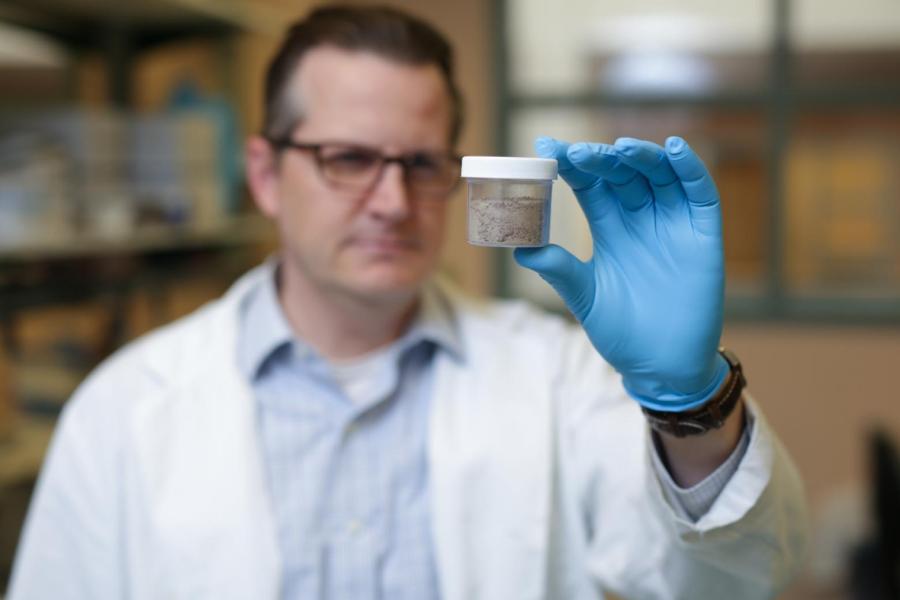

(COLORADO SPRINGS) — Colorado School of Mines is working on new research on how to best treat PFAS-contained soil, with testing happening at Schriever Space Force Base.
PFAS are a class of chemicals linked to serious health impacts like cancer, organ damage, and suppression of the immune system. These are the same kinds of chemicals found in water in the Fountain and Security-Widefield area back in 2016, believed to have come from firefighting foam used at what was at the time Peterson and Scheriever Air Force Bases.
A research team from The Colorado School of Mines is now developing and testing prototype treatment technologies for the destruction of PFAS associated with soils and sediments highly contaminated with firefighting aqueous film-forming foam (AFFF). The Mines team will evaluate three different soil and sediment treatment technologies as well as three destructive technologies that can handle concentrated waste streams. All fieldwork will occur at Schriever Space Force Base, just outside Colorado Springs, Colorado.
“The PFAS load in soils and sediments impacted by AFFF is immense and, if left untreated, will lead to significant long-term liabilities for downstream groundwater users,” said Chris Higgins, University Distinguished Professor of Civil and Environmental Engineering at Mines and lead principal investigator for the Mines-led project. “We’re excited to see how these technologies perform in a real-world, side-by-side comparison.”
The six technologies to be evaluated by Mines and corresponding collaborators are:
Smoldering combustion technology by Savron Solutions
In-pile thermal desorption (IPTD®) by TerraTherm
PFAS foam-assisted soil treatment (PFAST®) by Allonia
Hydrothermal alkaline treatment (HALT) by Aquagga
Supercritical water oxidation (SCWO) by 374Water
Ultraviolet-activated silica-based granular media (UV/SGM) by the University of Missouri-Kansas City
An additional team, from Clarkson University in New York, will test another three treatment and destruction technologies. Side-by-side testing at Schriever will start this fall and last about a year.