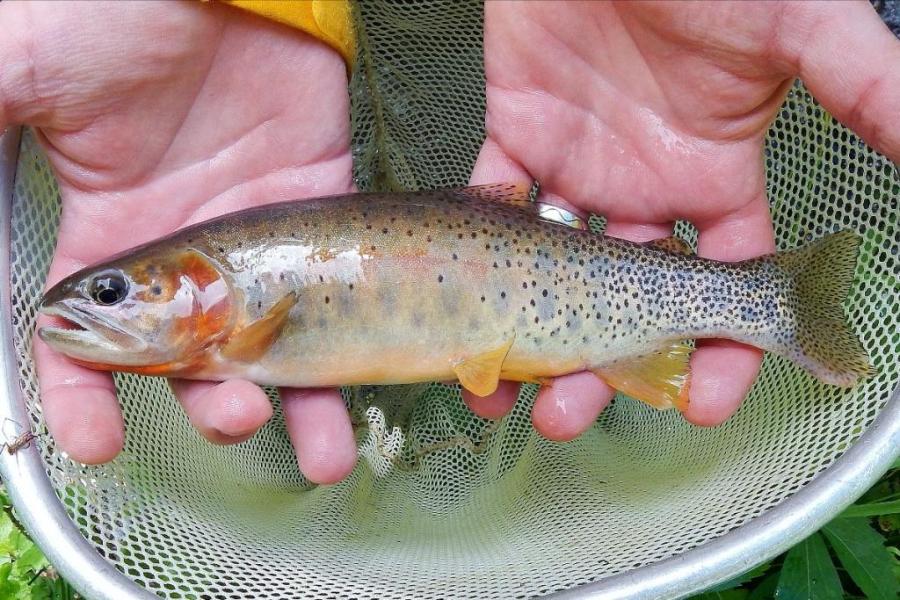

(FREMONT COUNTY, Colo.) — After eight years, biologists have found that a unique kind of cutthroat trout from Hayden Creek in Coaldale, Colorado is reproducing and their efforts to save the fish are succeeding.
In 2016, Colorado Parks and Wildlife (CPW) biologists found and removed 194 of the rare Hayden Creek cutthroat (HCC) when the Hayden Creek Fire burned 16,754 acres and almost wiped out the fish.
The fire produced ash and debris that washed over into creeks and rivers, ruining water quality, choking aquatic life, and destroying habitat. CPW said later rains overwhelmed the creek with thick, black sludge that poured into the Arkansas River and damaged fish and habitat for miles in the waterway.
After the fire, biologists found no fish remained in the creek.
The only survivors included 158 rare fish placed in an isolation unit at Roaring Judy Hatchery near Gunnison and 36 released in nearby Newlin Creek in Florence in hopes of surviving in the wild.
In 2017, biologists deemed Newlin Creek could be the new home for all surviving HCC fish, however, biologists found that none of the 36 HCC trout they had placed there originally had survived. They then began the task of reclaiming the creek of many existing fish that might compete with the HCC trout. Then, in 2018, 900 HCC trout were carried in bags up to the creek and released.
Since that first stoking, more than 8,000 fish have been released in Newlin and now, biologists are seeing and documenting evidence of natural reproduction in 2024.
“Our surveys this year found ‘young-of-the-year’ fish swimming with older class fish from previous stocking,” said Paul Foutz, senior aquatic biologist for CPW’s Southeast Region. “Although this does not mean the HCC in Newlin are a self-sustaining population yet, it’s a huge step in the right direction.”
Other streams have since also been stocked with HCC trout, and show good signs of survival and multiple age classes according to CPW.
“CPW’s mission begins with a vow to perpetuate the wildlife resources of Colorado and this is a perfect example,” Foutz said. “These fish have unique genetics and it’s our job to ensure they remain on the landscape for future generations of Coloradans.”