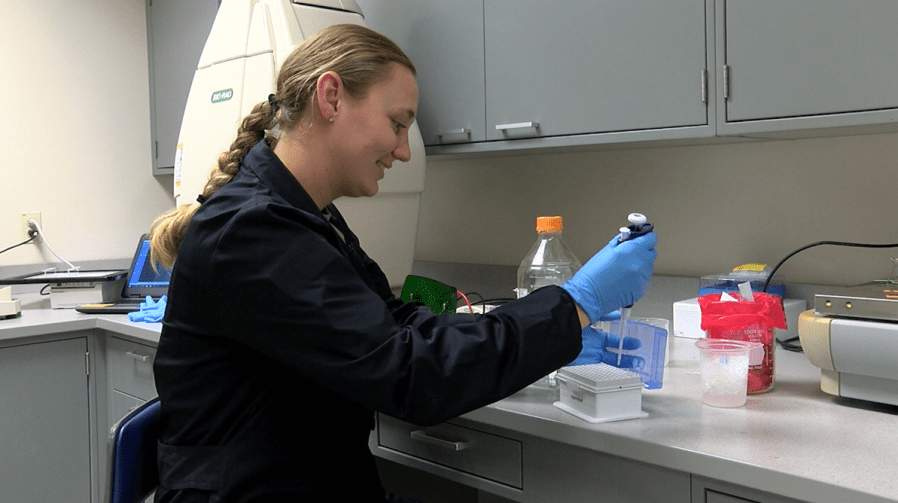

(COLORADO SPRINGS) —U. S. Air Force Academy (USAFA) cadets earned gold for continued research on an invention to help minimize the impact of Lyme disease during the International Engineering Machine (iGem) competition in Paris, France, Nov. 2-5.
“Basically, what we’re trying to do is find a better and faster way to detect and to inhibit Lyme disease,” said Megan DuMond, a senior at USAFA and a part of the Lyme-AID proejct.
iGem is the largest synthetic biology community and the foremost syntehtic biology competition for both university and high school students. During the competition, the 17-member team of cadets presented Lyme-AID, a genetically engineered system using a three-step biosensor to detect bacteria that causes Lyme disease.
“We looked at different project avenues that we could take,” said Amanda Schaefbauer, a senior at USAFA. “And we landed on Lyme disease due to inspiration that we found within members of the team — that was people we knew — who are afflicted by Lyme disease and just the prevalence that we found.”
In the United States alone, there are around 476,000 cases of Lyme disease per year.
“One of our team members had a family member, a friend that was affected by Lyme disease. So, it had a personal connection for us and we kind of dug into that,” DuMond said.
This led to the team choosing this project, advancing research toward the design of a cost-effective, efficient, easy-to-use detection system for early-stage Lyme disease.
If bitten by a tick, early detection is crucial for the best treatment and outcome.
“That’s one of the the issues that we noticed with Lyme disease and the need for this sort of detection,” said Schaefbauer.
This is illustrated in a childrens book, Tick Bite Triage, which was also produced by the team.
“Our whole goal with the book was to teach children about Lyme disease and reach that audience,” Schaefbauer said.
Cadets added they are excited to be the tool to help spread awareness about this disease, and create a stepping stone for others to use down the road.
“We didn’t cure Lyme disease or anything,” DuMond said. “But, we certainly made a contribution to the community being able to create an organism that institutions can work with… [and] there can be more opportunity for more people with more money to do more.”
The team will continue their research with the goal to make the first Lyme-AID patch prototype within the next few years.