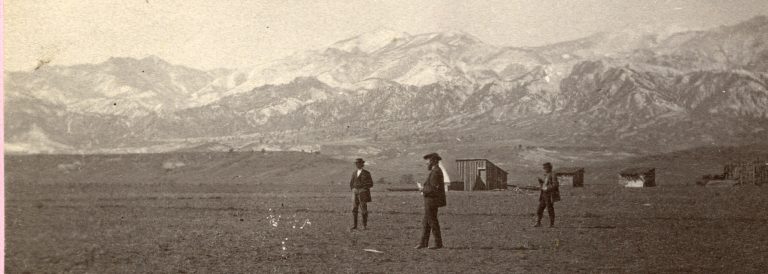

(COLORADO SPRINGS) — For a city that has changed so drastically just in the past decade, it’s hard to imagine what it was like at its beginnings. However, through historical pictures, the Colorado Springs Pioneers Museum offers a glimpse into the past and takes us back through time.
Thousands of years before the first settlement, Colorado Springs was home to various Native American tribes, which changed in the 1800s.
Downtown Colorado Springs, 1871, Courtesy: Colorado Springs Pioneers Museum
“The first permanent settlement in Colorado Springs was Colorado City, founded during the Gold Rush in 1859. That’s what we know today as Colorado City or Old Colorado City to our west. Colorado Springs itself emerged on July 31st, 1871,” shared Matt Mayberry, Director of the Colorado Springs Pioneers Museum.
The city’s genesis, spearheaded by General William J. Palmer, was unconventional. While many cities in the state are coined with identity such as Pueblo, the “steel city,” or Cripple Creek, the “mining town,” Colorado Springs was not born with an identity of its own.
“The way… Colorado Springs reinvents itself… every 20 years or so is a result of the fact that Palmer wanted this to be a community without a driving economic force… Palmer wanted this to be a place with a great climate and beautiful landscape,” Mayberry elaborated.
In its first phase, Colorado Springs, with its dry climate and fresh mountain air, flourished as a haven for individuals grappling with tuberculosis.
“We were America’s great sanatorium, we had over a dozen major TB treatment facilities, and at one point, a survey indicated that about 30% of our population was here for that reason,” Mayberry explained.
Eventually, advancements in medicine rendered these facilities obsolete.
“New ways of treating tuberculosis were largely driven by medical advancements made during World War II. So the same event that brought Camp Carson, Fort Carson, as we know it today, to Colorado Springs led to the demise of sanatorium efforts,” stated Mayberry.
A pivotal moment in 1941 saw the city’s council authorize the purchase of thousands of acres of land south of downtown to make land available to the War Department for the creation of Camp Carson.
“It was a decision on the part of local leaders to take a city that had really never had a military presence and become a military town… Now, today, we are home to five major military installations and the home of the U.S. Space Force,” said Mayberry.
Colorado Springs embraced change, and many of the buildings and their purposes over time are indicative of that. But one in particular–the U.S. Olympic Training Center.
“At the beginning of the 1970s, it was the home of Ent Air Force Base Air and NORAD [North American Aerospace Defense Command] was housed there. Prior to that, it was a TB sanatorium, the National Memphis Methodist Sanatorium. And so as Colorado Springs changed over time, that one location changed with it to be the new thing that was the focus of Colorado Springs,” said Mayberry.
As the city evolved into the U.S. Olympic Committee headquarters it earned the moniker ‘Olympic City USA’. The city’s evolution every couple of decades echoes Palmer’s vision—a community devoid of a single economic force.
As the city charts a trajectory towards unprecedented growth, becoming one of the nation’s fastest-growing cities, Mayberry says the essence of the city’s attraction has and will always remain.
Courtesy: Colorado Springs Pioneers Museum
Courtesy: Colorado Springs Pioneers Museum
Courtesy: Colorado Springs Pioneers Museum
Courtesy: Colorado Springs Pioneers Museum
“When I see people out on the trail hiking or biking or out with their family, I see them directly connected to who we are as a community and who we have been really since its founding as a place where people could enjoy the outdoors,” said Mayberry. “There is talk that, in the next 40 years, the population of Colorado Springs will be maybe a million people, which is hard to picture… And so our challenge, I think, is continuing to keep what is great about Colorado Springs as we continue to grow.”