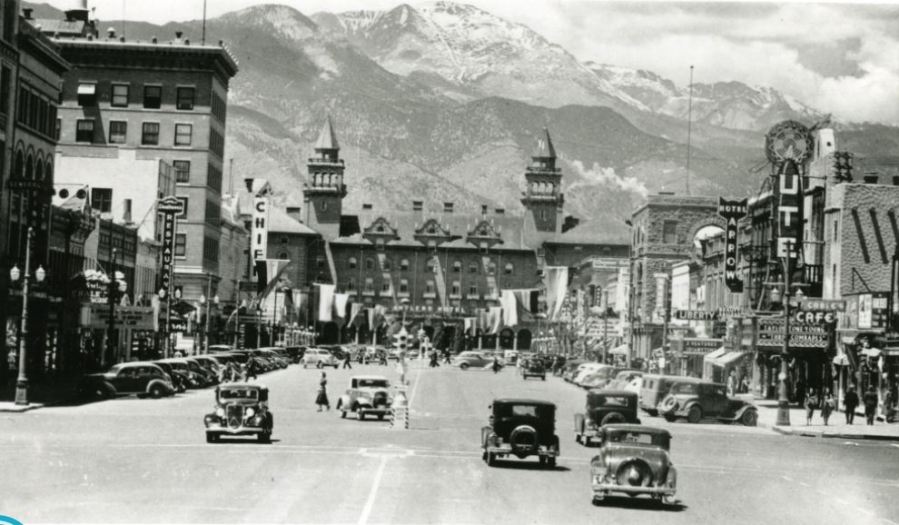

(COLORADO SPRINGS) — Rumor has it the Pikes Peak region is home to several mysterious myths, and FOX21 News is here to put them to the test.
We Are Colorado Springs and while some myths are true and some are false, there are others that remain a mystery, at least for now.
The truth behind the Pikes Peak Region’s most famous rumors and legends.
Known as a cultural crossroads, Colorado Springs is notorious for its natural beauty, warm hospitality, and a rich history.
“I think the history of Colorado Springs actually plays a big role in what makes it so fun and exciting to explore here,” said Alexea Veneracion, Director of Communications with Visit Colorado Springs.
Alexea Veneracion moved to Colorado Springs from Indiana in 2015 and quickly fell in love with the mountains. Veneracion learned about the state while working at Visit Colorado Springs and has a passion of sharing what she’s learned with the community. Back in April, Veneracion compiled a list of the top 13 Colorado Springs Myths on the Visit Colorado Springs website.
“Legends start for a reason,” Veneracion explained. “There’s always some truth behind any myth or legend.”
From its founding in 1871, Colorado Springs was advertised as a premier health destination for Tuberculosis treatment.
“That is true,” Veneracion said. “Colorado Springs when it first was marketed as a destination was very specific for wellness and Tuberculosis treatment in particular.”
About one-third of all visitors came to the area in search of treatment due to the abundant amount of sunshine.
“Colorado Springs became known for 300 days of sunshine, fresh mountain air, and somewhere you could get out and rest and rejuvenate,” Veneracion explained.
After the city’s founding and during the prohibition era, many believe those living here used tunnels located under downtown Colorado Springs.
“That is false,” Veneracion explained. “There have not been any official reports of tunnels under downtown Colorado Springs. However, there have been reports of tunnels under the businesses and Old Colorado City.”
In the late 1800’s, Old Colorado City was known for having a wild side.
“Those tunnels were used to get in between different businesses to pass alcohol around and included some brothel activity,” Veneracion said.
During her research, Veneracion discovered rumors that there may or may not be a tunnel under the Rabbit Hole, that used to be the Colorado Springs morgue, and was used to transport bodies. To learn more about this myth, visit ‘13 Colorado Springs Myth Busters‘.
Whether for business or pleasure, many traveled to Colorado Springs to bask in its beauty. One notable traveler, Katharine Lee Bates wrote the song ‘America the Beautiful’ after being inspired by the view from Pikes Peak.
“It is true,” Veneracion explained. “Katharine Lee Bates did a lot around Colorado Springs and one summer she got a group of fellow teachers together and they explored Garden of the Gods Park and then decided they wanted to climb Pikes Peak. She was very much into Pikes Peak and the outdoors, and the majesty of the mountain inspired her to write what was then a poem.”
The song “America the Beautiful” was inspired by Pikes Peak–true.
America’s mountain does not get all the glory, Garden of the Gods Park also gets a lot of attention, and many believe it was named as such because it is sacred ground.
“That is false,” Veneracion said. “The reason it was named is actually just a simple conversation between two land surveyors back in the day. One of them must have loved the idea of beer gardens and he said to his friend, ‘This would be a great place for a beer garden,’ and the other guy said, ‘A beer garden? This place is fit for the gods to assemble,’ and so they coined the Garden of the Gods from there.”
Garden of the Gods Park was named as such because it is sacred ground–false.
Many travelers also assembled at the Broadmoor, a legendary resort that also carries the tale that it used to feature a ski slope.
“That is true,” Veneracion said. “There was a ski slope at the Broadmoor, but it closed down in 1991 and that was mostly due to the inconsistent weather. It was very hard to maintain and keep it functioning, but it did exist, and people would go there, and ski, and you could do that right here in Colorado Springs.”
The Broadmoor used to feature a ski slope–true.
Veneracion said you can still see where the slope was when you look out toward the Broadmoor area.
While you’re peering over that way, keep your binoculars handy for this next myth, which may be Colorado’s most well-known myth–Bigfoot lives on Pikes Peak.
“That is unknown,” Veneracion explained. “There are rumored sightings of Bigfoot in this area, specifically Pike National Forest and along Pikes Peak that date back decades. As recent as 1990 there was a report that convinced everyone that they needed to put a sign on Pikes Peak Highway that says, ‘Bigfoot Crossing.'”
Bigfoot lives on Pikes Peak–unknown.
Whether you are a believer or not, Colorado Springs’ very own myth buster says the best way to get to know your city is to take a look from a different point of view.
“I do encourage everyone to go out, learn, and explore,” Veneracion explained. “It’s really fascinating the things that you can uncover.”
You can learn more about the myths and legends of the area at the Colorado Springs Pioneers Museum, the Pikes Peak Library District and Visit Colorado Springs.