
(COLORADO SPRINGS) — Sometimes you look at your weather app or something posted online and it looks wild! But then you turn on your TV and meteorologists tell you they need to wait for models to come together before they can tell you their snow totals for that exact same storm. Why is that?
The answer: meteorologists know how forecast models work.
Forecast models are in everything. They are what some phone apps use for the weather forecast, they are in weather website forecasts and we even use them for our on-air forecasts. But, what are they exactly?
“The way I like to think about weather models is they are a simulation of what the weather is going to be like. And those simulations are very similar to what we would expect in the real world that we get in video games,” says Dr. Anthony Torres, a numerical weather prediction specialist. Dr. Torres works on weather models every day.
Meteorologists use those simulations to get a good idea of what certain weather features will do in the future. They do a good job for the most part—however, there is a catch when you use them.
“When you are simulating what’s going to happen for a weather forecast you are making assumptions as to what the state of the atmosphere is going to be like. Once you start to get off course, you are getting further and further off course with time because the atmosphere that you are simulating isn’t necessarily the atmosphere that you are going to get,” said Torres.
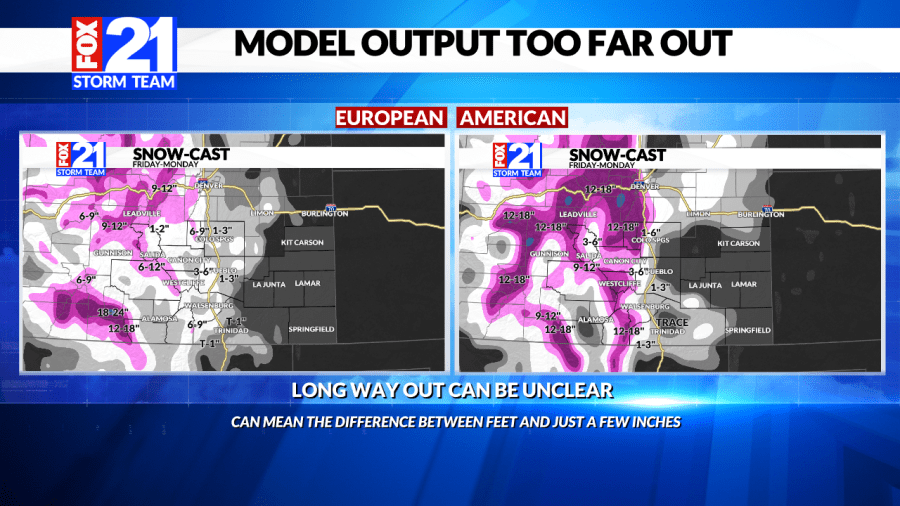
Here’s an example of how models can diverge from each other the farther your forecast into the future. As of Monday morning, the image below shows it is going to snow at the end of the week. The European model is on the left and the American model is on the right.
However, when we look at snow totals from both models, you can see below that the European model on the left in the image below shows that Teller County is getting anywhere from 6 to 9 inches of snow while the American model shows up to 18 inches of snow on the right. That’s quite the difference in how a storm can impact your day!
But a meteorologist has the expertise to separate fact from fiction.
“What a meteorologist does and where they really shine is that they can take a look at what is going on in the atmosphere with observations, compare that to the models, apply scientific principles, and then come up with an informed forecast as to what’s going to happen,” said Torres.
Here is a timeline of the forecast process for a meteorologist and how we use models. When we get 6 to 7 days out, the models show us the pattern is possible. At 4 to 5 days, meteorologists know a storm is likely to happen. As we get to a few days out, that’s when we can start answering questions about snow totals and how it will impact your day.
The key for you at home is knowing that model forecasts take time to agree on what is going to happen and to maybe take forecasts a long way out with a grain of salt. A great way to get information about the forecast is the Fox21 Storm Team app. The forecasts on that app are directly from the meteorologists on the Fox21 Storm Team and not just a printout of the models. We use our expertise to help interpret the models and give you the most up-to-date information on the forecast.