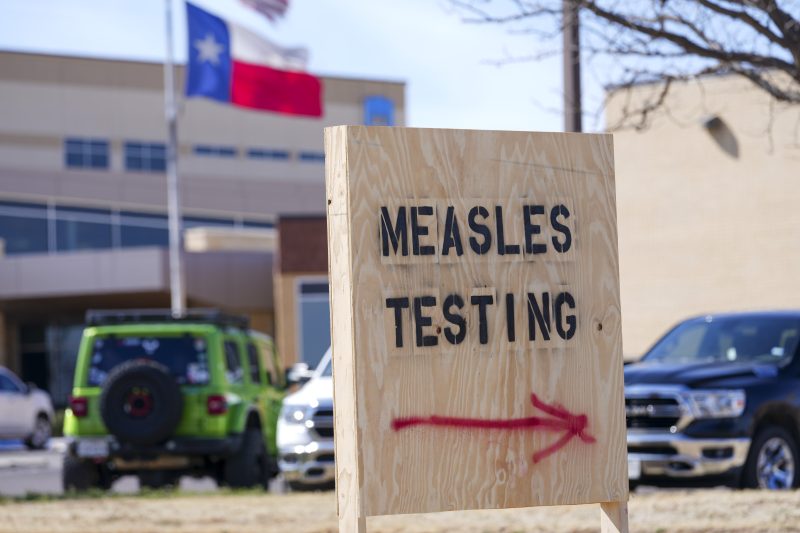

(PUEBLO, Colo.) — What is measles, the virus that the Colorado Department of Public Health and Environment (CDPHE) is warning the Pueblo community about after a confirmed case?
According to CDPHE, measles is a highly contagious viral disease that causes fever, rash, cough, runny nose, and red, itchy eyes. People with measles can spread the illness four days before the rash starts until four days after, and the incubation period for measles ranges from seven to 21 days.
Symptoms of measles include:
High fever
Cough
Runny nose
Red, watery eyes
Rash
The CDC said measles is highly contagious, and 90% of people who are not immune and exposed to measles will become infected. The virus can live for up to two hours in the air after an infected person leaves an area.
The CDC reports that measles can be serious at all age groups; however, children under 5 years old, adults older than 20 years old, pregnant women, and people with weakened immune systems are more likely to suffer from measles complications.
Common complications include hearing loss, which occurs in about one out of every 10 children with measles, and diarrhea, which is reported in less than one out of every 10 children with measles.
Severe complications include pneumonia, encephalitis, or swelling of the brain. CDC said that about one in five unvaccinated people in the U.S. who get measles are hospitalized. Pneumonia can occur in as many as one out of every 20 children with measles and is the most common cause of death from measles in young children.
Death is reported in nearly one to three of every 1,000 children.
Subacute Sclerosing Panencephalitis (SSPE) is also a very rare but fatal disease of the central nervous system that results from a measles infection; however, among people who contracted measles from 1989 to 1991, seven to 11 out of every 100,000 were estimated to be at risk for developing SSPE.
Dr. Rachel Herlihy of CDPHE said the good news is that measles is also easily preventable with the highly effective Measles, Mumps, Rubella (MMR) vaccine. With two doses of the MMR vaccine, it is 97% effective at preventing measles and offers lifelong protection.
CDPHE said experts are unsure why three in 100 people who get two doses of the MMR vaccine still become ill with measles if exposed to the virus, though one theory is that their immune system didn’t respond as well as it should have to the vaccine. Those with the vaccine who still contract measles typically report milder symptoms and are less likely to spread the virus to other people. There are no asymptomatic infectious carriers of the measles virus; only people who become ill with measles can spread it.
Data from CDPHE shows that measles cases across Colorado show only one to two cases in some years, with other years having no reported cases. CDPHE reports that the currently confirmed case of measles was an unvaccinated person who had reportedly traveled to an area of Mexico that is experiencing an outbreak.