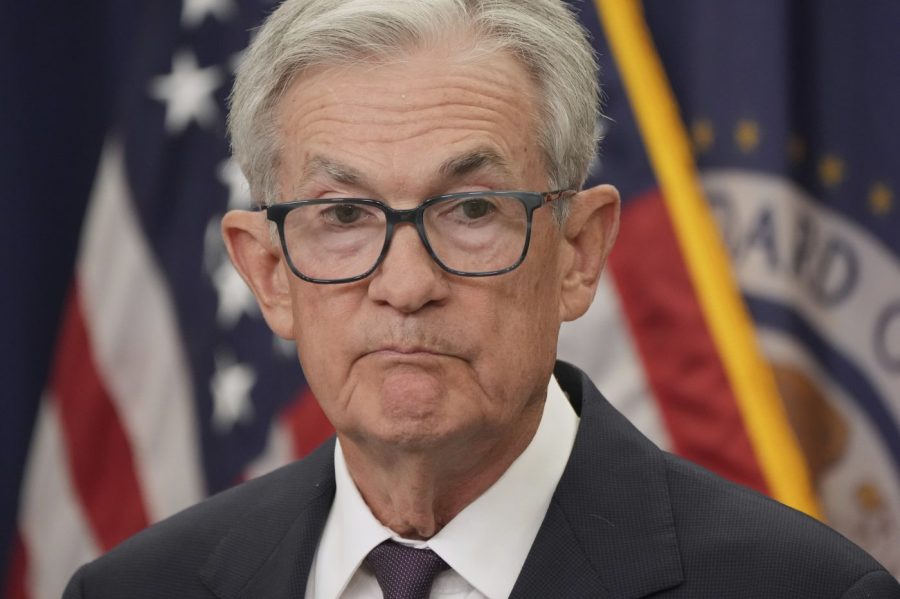

The Federal Reserve cut interest rates for the second consecutive month Wednesday as questions swirl about the true strength of the U.S. economy.
The Federal Open Market Committee (FOMC), the panel of Fed officials in charge of monetary policy, reduced its baseline interest rate to a range of 3.75 to 4 percent, cutting it by 0.25 percentage points.
Officials voted 10 to 2 in favor of the rate cut, with Fed board member Stephen Miran instead supporting a larger 0.5 percentage point cut, and Kansas City Federal Reserve President Jeffrey Schmid supporting no move at all.
After months of keeping interest rates steady despite pressure from President Trump, Fed officials changed course in September. The FOMC began bringing interest rates down in the last month and suggested in projections that they would likely do so again at least once more before the end of the year.
But Fed officials had to make Wednesday’s decision without key federal economic data amid the ongoing government shutdown. With the Bureau of Labor Statistics (BLS) mostly shuttered during the shutdown, the Fed had no federal jobs report for October to guide them.
Instead, the FOMC had to rely on a patchwork of private-sector data, a delayed consumer price index (CPI) and the Fed’s regular surveys of businesses and nonprofits for the latest insight on the economy.
“Although some important federal government data have been delayed due to the shutdown, the public and private-sector data that have remained available suggests that the outlook for employment and inflation has not changed much since our meeting in September,” Federal Reserve Chair Jerome Powell said in remarks to reporters.
“Conditions in the labor market appear to be gradually cooling and inflation remains somewhat elevated.”
Despite the wild card of a lack of federal data, Wall Street traders and analysts expected the Fed to cut rates Wednesday as central bankers face a difficult crossroads.
The U.S. labor market has slowed significantly throughout 2025, adding an average of just 29,000 jobs a month. The unemployment rate has risen to 4.3 percent from 4 percent in January, and the rate of hiring has slowed to levels not seen since the COVID-19 pandemic.
Inflation has also steadily risen since the summer, hitting an annual rate of 3 percent in September, according to the latest CPI data.
“There is no risk-free path for policy as we navigate the tension between our employment and inflation goals,” Powell said at the National Association for Business Economics conference in Philadelphia earlier this month.
With lawmakers nowhere close to ending the shutdown as of Wednesday afternoon, the Fed could have to make upcoming decisions without the benefit of federal data as well.
The White House said last week that the BLS would not produce another CPI report until the government shutdown ends, having only reopened to make sure the Social Security Administration had adequate data for the annual cost-of-living adjustment to federal benefits.
Powell said that while the Fed would be able to pick up on major shifts in the economy without federal data, it wouldn’t have “the detailed feel of things” it typically has in most cases.
He added that another rate cut in December “far from” a “forgone conclusion,” citing the major differences among Fed officials about the path ahead and concerns about the lack of clear data.
“We just don’t know what we’re going to get. If there is a very high level of uncertainty, then that could be an argument in favor of caution about moving, but we’ll have to see how it unfolds.”
Updated at 3:13 p.m. EDT