
(SOUTHERN COLORADO) — Ahhhh March 1, the first day of Spring is here! Well… the first day of Meteorological Spring that is. Oddly enough, the world of weather likes to divide its seasons into two different categories:
Meteorological
Astronomical
The reason behind this decision is to account for a few different factors, mostly having to do with the calendar and the Earth’s position relative to the sun.
Technically, the first day of Spring (and the first day of the other three seasons) is not always on the same day. Spring, for example, rotates between March 19 and March 20 most commonly. This year, 2024, the first day of Astronomical Spring will be on March 19. The mid-March day is usually the one thought of as more ‘traditional’ for the first day of the season.
Meteorologists, however, don’t like that the date changes. It makes data collection inconsistent and it’s cumbersome to identify exact trends with our weather patterns.
Therefore meteorologists define Meteorological Spring as March 1 – May 31. Everyone else defines Spring based off of Earth’s position relative to the sun—or Astronomically.
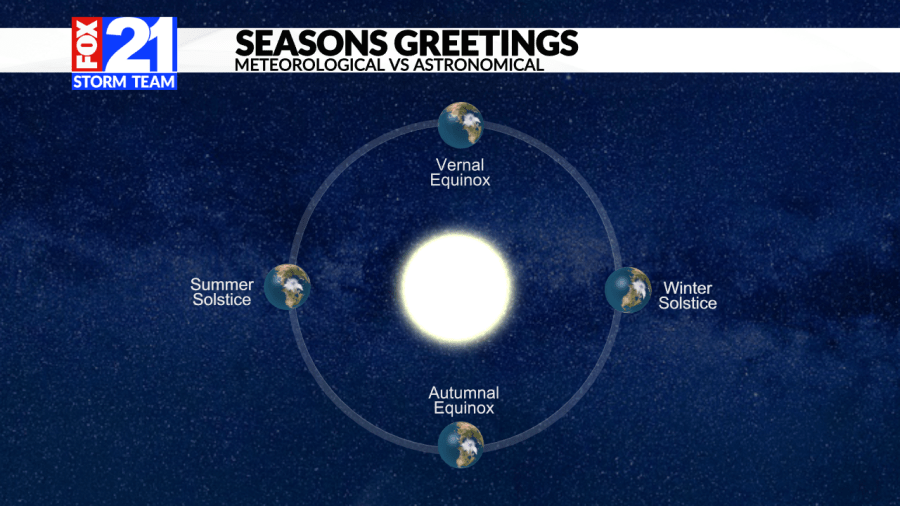
Astronomical Spring, sometimes referred to as Vernal Equinox (yes, a completely different name) accounts for the point at which the center of the sun is directly over the equator. Because of this, everyone gets equal amounts of sunlight—as depicted in the picture above.
This is also where you may have heard the phrase ‘equinox: equal day and equal night’.
Another key factor to point out when it comes to our changing seasons is the importance of Earth’s tilt. The exact measurement fluctuates ever so slightly, but in general, our planet is tilted at a roughly 23.5-degree angle.
As our seasons continue to change, summer will eventually come around yet again. During this time the Northern Hemisphere will receive the most direct rays of sunlight with a particularly strong focus over the Tropic of Cancer. You can thank Earth’s 23.5-degree tilt for this one. At this point in Earth’s orbit, the Northern Hemisphere is experiencing the longest days and warmest temperatures.
For Winter, everything is the opposite. The Nothern Hemisphere receives the least amount of direct sunlight and will have the shortest days. Temperatures will also get much colder. At this point in Earth’s orbit, the Southern Hemisphere is enjoying its summer.
It’s kind of odd to think about the weather in a place such as Australia. Their Christmas time temperatures are usually in the 70s and their mid-July temperatures can drop into the upper 40s.
So what exactly does Spring usually look like for Southern Colorado? Above, we can see that meteorological Spring (March, April, May) will typically warm up from the lower 50s to near 80 degrees by the time Summer starts.
For those of you who may not necessarily enjoy Winter quite as much, there is a light at the end of the cold tunnel. March is a great month for experiencing a variety of weather changes.
Use the slider to compare the moisture and temperature outlook from the CPC
Currently, the Climate Prediction Center (CPC) is keeping an eye on above-average moisture for all of Southern Colorado. This doesn’t mean that it’s going to rain or snow every day, but a more frequent storm system may move through the region for the month.
Temperatures, on the other hand, appear to neither favor above or below average for our neck of the woods. Climatologically speaking, we should be quite ‘normal’ for March when it comes to temperatures.
Use the slider to compare the moisture and temperature outlook from the CPC
For the Spring season as a whole, things look rather average for Southern Colorado. As of right now, the CPC isn’t picking up on any drastic signal changes but that doesn’t mean the weather will be calm around here. It just means we can expect the same type of weather that we usually do for our Spring across the region.
As most of us know around here, Colorado weather can be anything but normal so be sure to stick with the FOX21 Storm Team for future updates!