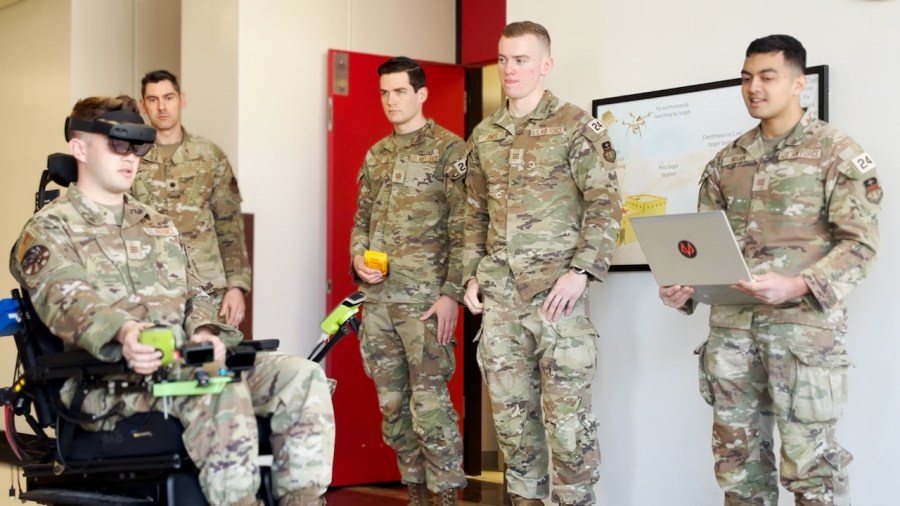

(COLORADO SPRINGS) — At the United States Air Force Academy (USAFA), cadets are empowered to take their academic learning to new heights. For a group of five seniors, their capstone project focuses on developing a one-of-a-kind wheelchair that holds the potential to transform lives.
“What we challenged these students with, and the groups that have preceded them, is to create a gaze, or an eye-gaze interface for a mobility device,” said Brian J. Neff, USAFA Vice Dean for Academics. “In this case, they’re using a wheelchair, a highly sophisticated wheelchair, but what we’re trying to do is control the wheelchair only with using their eyesight and voice commands.”
This team of five cadets each have different majors, backgrounds and driving forces, and they’re all coming together to make this challenge come to fruition. In taking on this capstone project, they’re not only putting forth their brain power, but also dedicating hours of time to see the wheels turn.
“We expect every group to put in about 120 hours per semester,” Neff said. “This group has been working on this project now for about 55 lessons, give or take a few.”
Each cadet holds a special role in contributing to the success of the gaze-assisted wheelchair.
The capstone project began in 2020 when a cadet took on the challenge of reverse-engineering a motorized wheelchair. Since then, it has passed through the hands of four groups of cadets, each leaving their mark and propelling the project forward.
“I basically told them at the start of each semester, I’ve told them the same challenge,” Neff said. “I want to be sitting at some point in the lab and I want to be able to look exactly where I want to go and have the chair require no other interface than just my eyesight and potentially voice commands.”
On Thursday morning, a team of USAFA cadets showcased their capstone project of a gaze-assisted wheelchair.
On Thursday morning, the team showed the gaze-assisted wheelchair in action and explained the different roles and responsibilities each member took on. Among them, USAFA Cadet 1st Class Lucas Jones shared his work on the coding elements and explained why working on the project is meaningful to him.
“You can kind of imagine with these technologies are in use, it’s going to be a user that doesn’t get a lot of mobility,” Jones said. “[Who] doesn’t have a lot of independence and so when we can kind of keep that end result in mind and work towards that, it’s a lot easier to stay motivated to put in the long hours on the project.”
Cadet 1st Class Cade Isley demonstrated the wheelchair in action.
As the wheelchair moved through the halls of USAFA, the driver, Cadet 1st Class Cade Isley had his own special connection to why he felt called to become part of this capstone project.
“My little cousin was born with a rare mitochondrial disease and so when she was born, [the] doctor said she wasn’t going be able to like, walk or talk or anything, but she’s doing just fine,” said Isley.
While Isley’s cousin Riley is not at USAFA, there is no doubt she is felt in his heart every minute he spends working on this project.
“It helps me design to users like her, but also keeps me motivated for the project,” Isley said. “I’m like, well, if I don’t work as hard as I can, then I’m letting her down, you know, every time I tell her about stuff like this year, she gets excited.”
Courtesy:
Cadet 1st Class Cade Isley
Over the years, this capstone project has seen enhancements thanks to the work of many cadets, but this particular group has distinguished themselves by creatively integrating technology which has left a lasting impression.
“This group of five students has probably worked better than any group of five that I’ve worked with up to this point,” Neff said. “But what was really exceptional about this group is that each one of them had their own specific reason why they were excited about the program, but also their own specific skill set that they bring.”
With graduation on the horizon, these cadets are getting ready to spread their wings and take on future challenges, but before saying goodbye, they have the opportunity to present their work to someone with mobility-related disabilities.
“It’s really powerful and we’ve actually gotten to meet a few of the potential users for this technology,” Jones said. “That in and of itself has just been so cool to see because they light up, they get smiles on their faces. We’re all laughing and joking and just really excited about what the future could hold for them.”
Not only does this team of cadets have the opportunity to engage directly with a user for the specialized wheelchair, but they also have the potential to secure a patent for their distinguishable and hard work.
“There is a couple of unique things that I think this team has done with their interface to improve upon the work of previous teams that I think is worthy of a patent,” Neff said. “The way they’re interfacing, the way they’re controlling and the way they’re bringing some other subsystems to play, I think is worthy of a patent.”