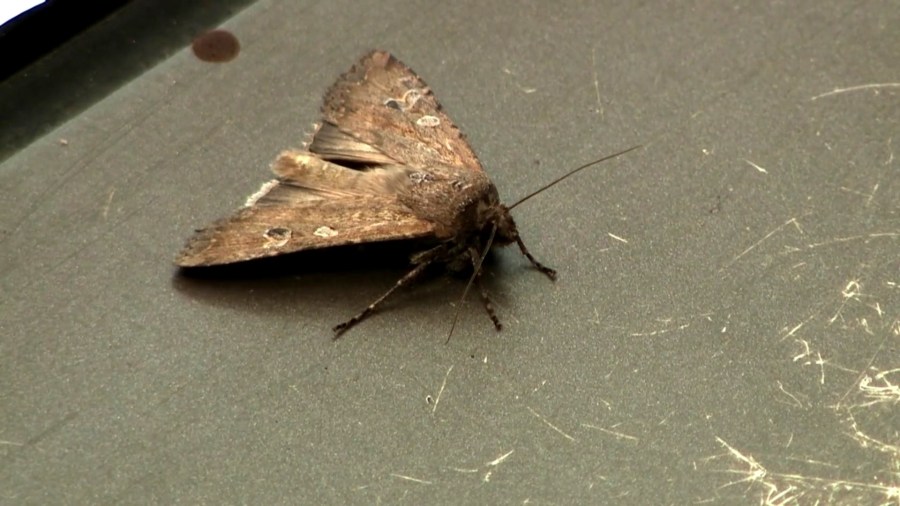

(COLORADO) — It’s officially time in Colorado–time for graduation parties, cookouts, sunshine… and miller moths.
With spring on its way out and summer taking the stage, the warming temperatures also bring a familiar set of wings to the Pikes Peak Region. The miller moth (a common name for the army cutworm moth) feeds on nectar in late spring through early fall and tends to migrate in the springtime.
According to Colorado State University (CSU), the miller moths’ presence in the Pikes Peak Region is part of their migration to higher elevations, where they seek more flowering plants to feed on. During outbreak years, CSU said miller moth flights typically last five to six weeks, generally starting between mid-May and early June. However, they tend to cause the most nuisance problems for only two to three weeks.
The miller moth migration is underway in Colorado. (KDVR)
According to CSU, several different things influence cutworm outbreaks: wet weather and extremely cold winter conditions may kill many of the caterpillars. The effectiveness of natural enemies, such as ground beetles and parasitic wasps, helps regulate cutworm populations. Plowing fields where cutworms develop kills many, as does tilling gardens.
“Miller moths avoid daylight and seek shelter before daybreak. Ideally, a daytime shelter is dark and tight. Small cracks in the doorways of homes, garages, and cars make perfect hiding spots,” said CSU. “Often, moths may be found clustered together in particularly favorable sites. Since cracks often continue into the living space of a home (or a garage, car, etc.), a ‘wrong’ turn may lead them indoors. At night, the moths emerge from the daytime shelters to resume their migratory flights and feed.”
How to keep them out of your home
As with most creatures with which humans have to cohabitate, miller moths just want a safe, dry place to rest before continuing on their journeys to higher elevations. That can be a problem, however, when that safe place is in your garage or home, and they suddenly swarm on your way to your car. So, how can you mitigate the meeting of the millers?
CSU recommends sealing any obvious openings ahead of the migration, particularly around windows and doors. Also, reduce lighting at night in and around the home during flights. This includes turning off all unnecessary lights or substituting with non-attractive yellow lights.
According to CSU, army cutworm moths are also very sensitive to certain noises, making erratic flying movements in response. Among the sounds which elicit the greatest response are jingling keys, dog tags, rattling coins, and crumpled pop cans.
The likely reason for this is that certain sound frequencies are produced to which the moths are sensitive. Many cutworm moths make evasive movements in response to frequencies used by bats during echolocation of prey. Since bats are an important predator of night-flying moths, rapid evasive movements are a means of protection.
Unfortunately, insecticides have little or no effect in controlling millers, CSU said.
How to get them out if they’ve found their way in
CSU said there are several ways to get miller moths out of your home, including swatting them or vacuuming them (don’t worry about harming the population, they are not an endangered species).
You can also build a fairly simple home trap by suspending a lit light bulb over a bucket partially filled with soapy water. Moths attracted to the light often will fall into the water and be killed. Of course, there are obvious dangers when bringing water and electrical equipment in close proximity, so care should be given to the situation, CSU said. Consider using a GFI receptacle for safety.
And if all else fails, you can be reassured that miller moths do not lay eggs during the migratory stage, so once they’re gone, they’re gone for good. At least, until next spring.