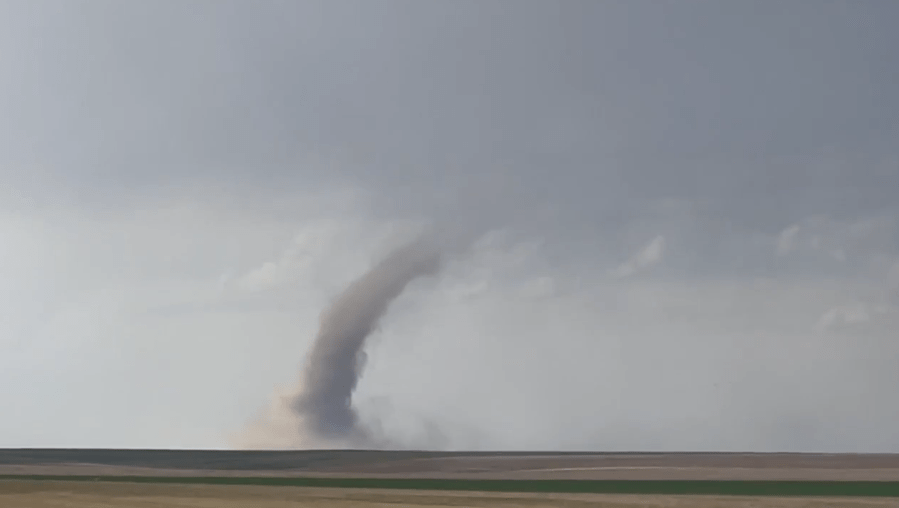

(NATIONAL) — “Twisters” swept through the nation on opening weekend, making $80.5 million in ticket sales from theaters in North America. The sequel to the 1996 blockbuster “Twister” is full of hair-raising action, but how does the movie compare to real life?
“Twisters,” like the original movie, follows competing storm-chasing teams as they get up close and personal with one of the world’s most dangerous and destructive weather phenomena. According to the National Oceanic and Atmospheric Administration (NOAA), the original movie sparked a surge in people pursuing meteorology degrees, and many people speculate that the new movie may have the same effect.
According to NOAA, many meteorologists can have a “love-hate” relationship with “Twister.” While some were inspired to pursue their careers by the original movie, they hate seeing bad advice about riding out a storm in risky locations. While the creators of the sequel spent time learning from experts at NOAA, there were still plenty of science-fiction moments.
Fortunately, the NOAA compiled a series of videos highlighting how the movie “Twisters” lines up with reality. From how to find safe shelter to whether a fire tornado can happen in real life, the videos cover multiple examples pulled from the movie, several of which are explained below.
Overpasses are one of the worst places to seek shelter from a tornado.
The main characters in “Twisters” abandon their vehicle to run for shelter under an overpass in one scene, leading to a terrifying scene where a tornado passes directly over them. According to the NOAA, overpasses may be one of the worst places to seek shelter, as they can put you in greater danger of being injured or killed by flying debris.
The NOAA recommends paying close attention to forecasts and not being on the road at all during severe storms in the first place. But if you find yourself on the road during a tornado warning, try to get off the road and seek sturdy shelter. If that’s not an option, pull over and park, stay in the car with your seatbelt on, put your head below the windows, and cover yourself. If you think you can get lower than the roadway, exit your car and lie down in that area, covering your head with your hands.
None of these options are guaranteed to protect you, but they are better than hiding under an overpass.
How to be notified in advance of a tornado or severe weather.
Tornado movies often show tornadoes coming out of nowhere without warning. However, the National Weather Service is constantly watching the environment for tornadoes and severe storms, and they usually activate tornado warnings 15 to 20 minutes in advance. You can be sure to be aware of these alerts in several ways. Mobile apps and wireless emergency alerts on your phone, TV, radio, NOAA radio, and sirens are all activated to keep locals aware of imminent threats.
It’s never possible to tame a tornado.
The original movie, “Twister,” followed storm chasers trying to use new equipment to get data from a tornado, but “Twisters” takes it to an entirely new level by making the goal to stop tornadoes in their tracks. Though it’s an exciting idea, the NOAA explains why it’s impossible.
Tornadoes and the storms that form them are massive and complex systems created by immense amounts of energy. There’s no science to suggest that any chemical would have the capability to disrupt storms, as the main characters of the film believe. Even if such a chemical did exist, the amounts required to make an impact would make it impossible to deploy with the speed and precision necessary.
Additionally, the side effects of the chemicals would be unknown and could create as much damage as the tornadoes themselves. Weather is a balancing act, and disrupting it could create massive negative environmental impacts.
Do “fire tornadoes” exist?
The fire tornado scene in “Twisters” is packed with dramatic visuals, but do fire tornadoes really happen? According to the NOAA, though there are no known cases of a tornado impacting an oil and gas refinery and catching fire, there have been cases of existing wildfires creating extreme heat that caused the development of severe thunderstorms and even tornadoes.
In 2018, a fire in Redding, California, created a supercell storm that spawned a large tornado that caused EF3 damage. Fire was seen in the lower levels of the tornado. This was exceptionally rare and a different phenomenon than the small, brief fire whirls occasionally seen in wildfires.
NOAA National Severe Storms Laboratory’s (NSSL) mission is science to save lives and property.
Both movies have created an image in people’s minds of storm chasers getting dangerously close to tornadoes. Social media creators have also gotten in on the trend, posting harrowing videos of drivers getting dangerously close to the deadly storms. The NOAA NSSL is interested in science rather than drama.
For more than 60 years, NOAA has been getting out into the field to study the storms in the wild, bringing instruments to the storms and testing scientific hypotheses. Safety is their number one priority. Their studies have made longer lead times and better forecasts possible.