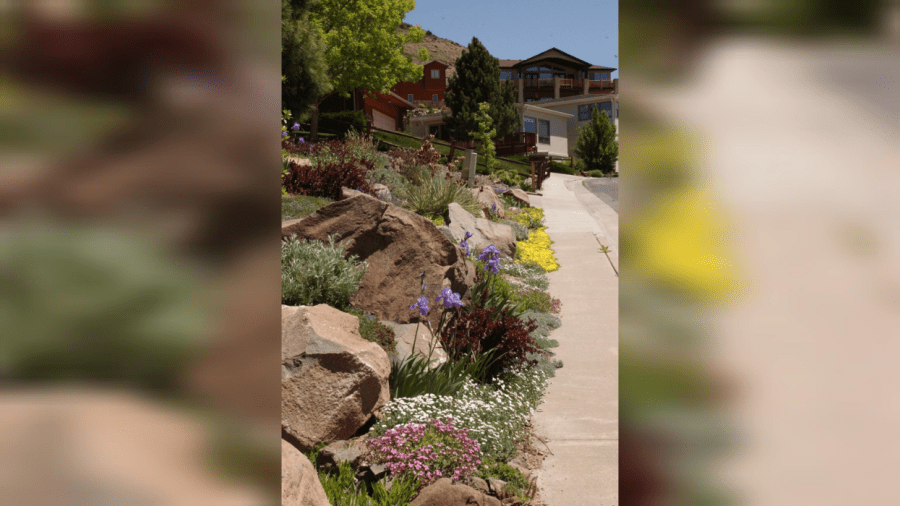

(COLORADO) — The Pikes Peak Region has a semi-arid climate, with only 13 inches of rain and three inches of snow on average each year, making it necessary to irrigate flowers, trees, and lawns to keep them healthy, but lawns and some plants require much more water than the native climate normally sustains, and that’s where Xeriscaping can come in.
Xeriscaping is a landscaping approach that utilizes drought-resistant plants, grasses, and shrubs to create an environment that requires less water to maintain. As a bonus, many xeriscape designs require less maintenance and yard work and can reduce reliance on chemical fertilizers.
Reduce water usage
Colorado Springs Utilities (Springs Utilities) estimates that the average household uses about 35% of its water for landscaping in Colorado Springs. Kentucky bluegrass, the most common grass used in lawns in the Pikes Peak Region, requires 20 gallons of water per square foot from April through October, in addition to the water gained from rainfall.
Some homeowners go for an option called “zeroscaping,” choosing to replace lawns with loose rocks and gravel in an attempt to remove all need for maintenance, but in addition to looking barren, over time, weeds and debris accumulate in the rocks, making maintenance more difficult in the long run.
According to Springs Utilities, however you choose to arrange your landscaping, it’s important to plan ahead and group together plants that have similar watering needs, while installing automatic watering systems to maintain the plants. While this is possible with any type of landscaping, a well-planned xeriscape garden can reduce water usage by a significant amount by following these seven principles:
Plan your design
Improve your soil
Irrigate efficiently
Use drought tolerant plants
Limit turfgrass
Utilize mulch
Maintain your landscape
Plan your design
According to John Murgel with Colorado State University Extension, successful xeriscaping starts with understanding your site. Matching the right plants with the right place will make your garden much more successful in the longrun than forcing the landscape to match the plants.
Consider factors such as the properties of your soil, sun exposure, water flow across the property, and any potential microclimates you can take advantage of.
Improve your soil
According to Murgel, with xeric plants, you may not need to add as much compost and organic matter to your soil as you would with other plants. Compost and organic matter retain moisture, and drought-tolerant plants prefer a drier environment. Most xeriscape soils work best in the three to five percent organic matter range, so rather than composting, some yards may simply need the soil to be loosened if it is compacted.
As Colorado Springs is semi-arid, it is usually not necessary to add gravel or sand into the soil to improve drainage, as the typical challenge is getting enough water for plants, rather than too much. If water is pooling in your yard, you likely have a lakefront property, in which case, feel free to plant flowers and shrubs that require more water, or you have a leak that you need to get fixed.
Irrigate efficiently
According to Springs Utilities, a well-designed xeriscape yard, including native grass or xeric plants, can be watered as little as once a week or even once a month.
Drip irrigation is a good option to prevent evaporation, but it’s best to regulate the frequency to encourage the plants to develop deep and hearty root systems. Dripping infrequently but for a long time, soaking the soil, encourages expansive root growth, according to Murgel. Long and infrequent waterings help your plants grow their roots to seek water deep in the soil, and then they are adapted so that when water restrictions hit, they aren’t as affected.
However, with xeric gardens, you may not even need an irrigation system at all. While they are getting established, you can hand-water your plants, and in time, they will be able to thrive on natural precipitation alone.
Use drought-tolerant plants
When thinking about xeriscape landscaping, many people think of pointy cacti and thorny bushes, but there are hundreds of lush and colorful flowers, trees, and shrubs that require less water and can create stunning views while providing natural resources for local birds and insects.
Native plants can be a good choice, but it really only matters whether the plant is suitable for your area’s climate conditions.
Springs Utilities has a “Find a Plant” page in which users can filter their search with a myriad of criteria to look for appropriate trees, shrubs, flowers, grasses, and vines.
Limit turfgrass
Because of its prevalence in lawn design during the 1970s and 1980s, Kentucky bluegrass is the type of turfgrass that people associate with lawns. Still, other equally beautiful grasses, such as buffalograss and tall fescue, can grow naturally in Colorado’s climate and require less water.
Replacing lawns with xeric grasses or drought-tolerant perennials rather than simply ripping out established turf is a better way to ensure your yard doesn’t turn into a barren wasteland.
Some people opt for artificial turf, but it’s not always the most efficient choice. Artificial turf can get very hot in the sun, requires water to cool down or clean, has similar problems with debris as gravel, and eventually will end up in a landfill.
Utilize mulch
Mulch plays an important role in xeriscaping by reducing evaporation, suppressing weeds, and protecting plant roots from extreme temperatures.
Mulch can be organic, such as woodchips, or inorganic, such as gravel. Woodchips work well in shady spots, such as under trees or around shrubs, but if it is too exposed to the sun, it can repel water.
Gravel can work well for xeriscaped gardens in the full sun, as it allows water through to the soil, and it doesn’t break down and need to be replaced. To be effective as a weed barrier, it needs to be at least four inches deep, according to Murgel.
Maintain your landscape
There isn’t much more maintenance for xeriscaping than traditional landscaping, in terms of time and effort spent, according to Murgel. You will trade in mowing once a week for cutting back perennials once a year and pulling some drought-tolerant weeds. Maintenance should also reduce over time as plants are established and require less watering.
Xeriscaping challenges
As with anything in life, certain challenges can accompany the benefits of xeriscaping. Whether it’s the upfront cost, time invested in establishing your garden, or legal restrictions in your area, it’s important to research the pros and cons of xeriscaping before committing to it.
The upfront cost of xeriscaping can be anywhere from $5 per square foot to $20 per square foot, which is somewhat more expensive on average than traditional landscaping, which ranges from $4.50 to $17 per square foot. However, the lower monthly maintenance cost of xeriscaped yards can quickly save money in the long run.
It can take time to condition a yard for xeriscaped plants and then more time for the plants to get established enough to guarantee success, so it can take patience, but it can be worth the wait.
Courtesy: RJ Sangosti/MediaNews Group/The Denver Post via Getty Images
It’s important to check the homeowners association restrictions in the area you live in and compare them to your legal protections. Some HOAs may have restrictions on landscape design, including what plants are allowed. However, Colorado has passed many laws protecting homeowners’ rights to plan landscapes that require less water.
As water rates rise, it’s becoming necessary to find ways to conserve water and lower costs, and xeriscaping can help stop you from feeling like your money is being wasted on your lawn, while giving you a beautiful and vibrant retreat in your own backyard.