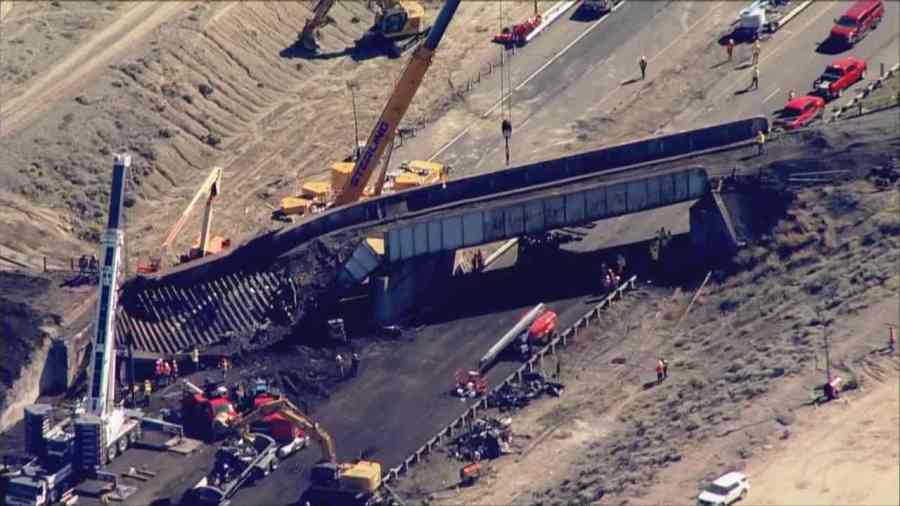

(PUEBLO, Colo.) — The National Transportation Safety Board (NTSB) released its final report on the likely cause of the October 2023 train derailment that killed a truck driver and closed I-25 for several days.
In October 2023, a BNSF train traveling south derailed about five miles north of Pueblo, and the derailment caused the collapse of a bridge onto the southbound lanes of I-25, killing 60-year-old Lafollette Henderson, who was trapped under the bridge.
In October 2024, the NTSB released a report stating the cause of the derailment was a failure of a thermite weld, or a method of joining two rails together using heat. The two sections of rail had been welded with mismatched heights of about 3/16 of an inch and the gap at the base was partially filled with extraneous molten weld material or “weld flash.”
NTSB said the weld flash contained voids or hollow spots susceptible to facilitating a crack within the rail along with oxides, and entrained nonmetallic materials. An examination showed that fatigue cracking had started near the weld flash and moved up until the rail fractured.
NTSB’s report said BNSF welding procedures allowed for the joining of rails with different profiles that can result from rail wear or a joint between different rail weights, but if profiles differ by 0.125 inches, a compromise kit must be used. The rails must be aligned at the top then a mold provided in the kit is used to prevent a gap at the base of the rail that can allow for weld flash to pool under the rail.
NTSB interviewed the welder who made the weld but he did not recall performing the weld several months earlier. NTSB said the welder was properly trained, demonstrated knowledge of when a compromise kit should be used, and reported to NTSB he had used them in the past.
NTSB concluded that it was likely a compromise kit was not used for unknown reasons and the resulting weld flash accumulated in a gap at the base of the rail, which served as stress concentration and formed fatigue cracking from the repeated stress on the rail. NTSB also said that while the rail was inspected, no defects were found, and NTSB gave an example of Ultrasonic testing that could have missed the defect as the geometry of the rail can make defects at the base difficult to detect.
As a result of the derailment, BNSF adopted a policy of inspecting every failed weld and why they failed, if welding practices contributed to the failure, the welding team is retrained. Material was also distributed to employees to emphasize the importance of proper kit selection. BNSF also implemented mandatory audits to be conducted by welding supervisors, and each supervisor must inspect 10 random thermite welds per month to confirm the correct kit was used.